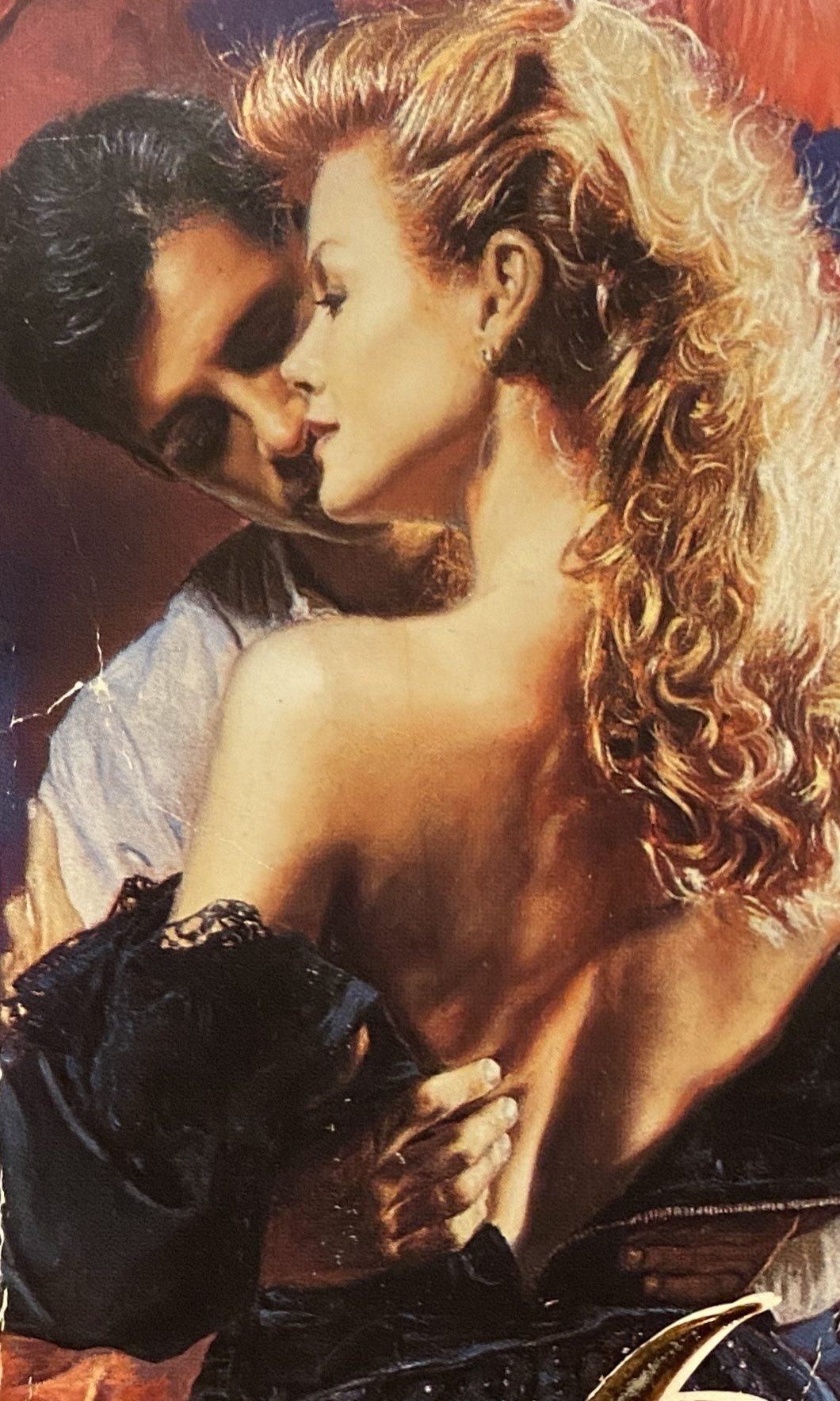
There appears to be a gap in romance scholarship concerning sex work in popular romance. In place of substantial research on how sex work and sex workers’ stories appear within the genre, for instance, from a labor perspective, there, instead, exists a mountain of research concerned with examining romance’s perceived proximity to pornography by romance readers, authors, and people who do not read romance. Many of the arguments boil down to romance is porn for women, that calling it porn diminishes its value, or that women seek it as an alternative to porn. The validity of sex work as work is hardly addressed at all.1
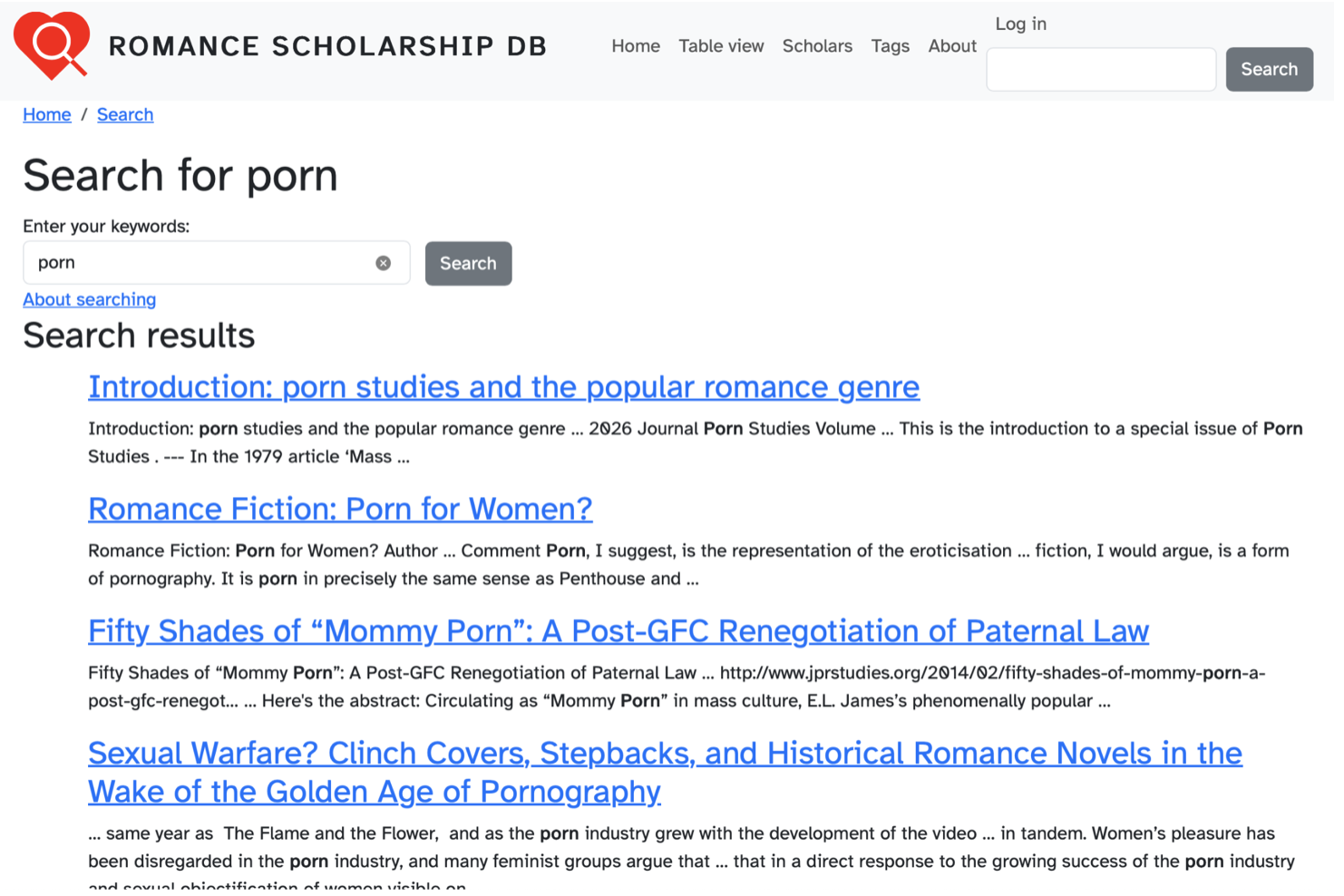
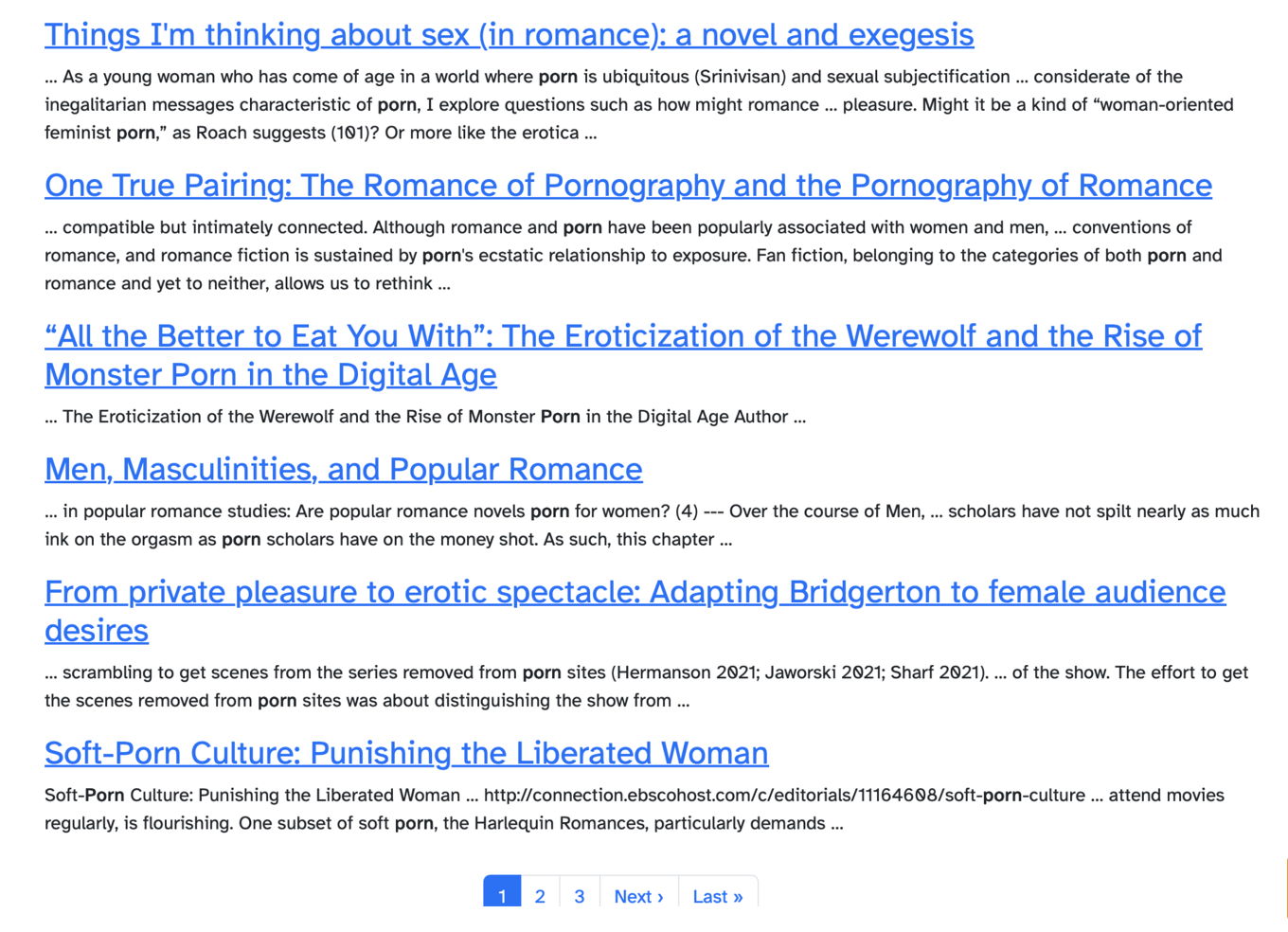
search results for porn on the Romance Scholarship Database
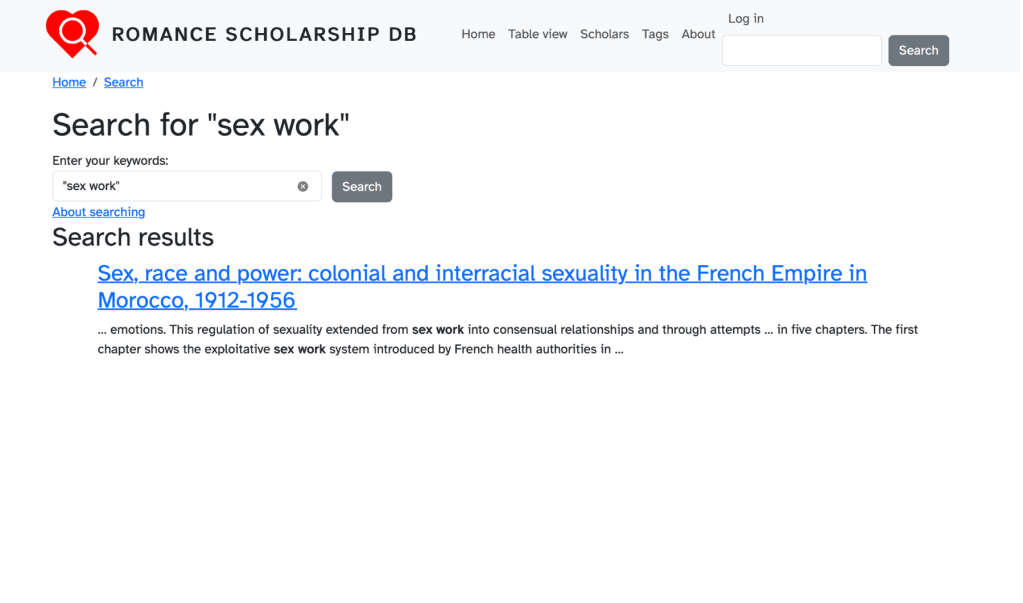
I don’t have an interest in adding to this discussion of “is romance porn and if yes is that a good thing or a bad thing?”2 because I find this discussion boring at best and offensive at worst:3 the way romance authors, readers, and academics speak or write about pornography – on social media or in academic papers – is so often laden with contempt for sex workers and the people who produce pornography.4 5 6 7 To be fair, it is not an aberration that analysis of sex work is so often excluded in scholarship of popular romance, this line of inquiry remains lacking across media studies.8
One relevant piece of romance scholarship I found came from Creating Identity: The Popular Romance Heroine’s Journey to Selfhood and Self-Presentation by Jayashree Kramble. In her chapter on work, Kramble analyzes romance, gender, and work within the romance novels Dreaming of You by Lisa Kleypas and Naked in Death by J.D. Robb. Interestingly, both of these novels feature sex worker characters in tertiary roles: Sara Fielding (Dreaming of You) is a novelist, her most famous work is about a fictional sex worker – she did extensive research interviewing several sex workers for her novel and Lieutenant Eve Dallas (Naked in Death) is a cop investigating the gruesome murder of sex workers in a futuristic New York City where prostitution is legal. Writes Kramble:
Whether in novels that show women trying to earn a living in a hostile society that wants to bar them from the labor market, or novels that show them in a male-dominated field, or novels that elevate the worth of the activities, jobs, and industries associated with women (arts, education, human services, food, fashion, etc.), the genre normalizes the idea that only a woman has the right to determine how and when she does physical, mental, and creative work. Just as crucially, it models how the heroine can choose to do or decline emotional labor.9
While I appreciate that Kramble points out the genre normalizes women making decisions about work, I do find it curious that sex work is excluded from this list of industries associated with women. For me, this is a problem and I would have clocked this elision regardless, but it is especially glaring considering sex workers – their stories, their bodies, their deaths – are exploited in service of the main characters’ arcs: in these texts, sex workers exist to be fictionalized for someone else’s profit or to be violently murdered (whose body do you suppose is “naked in death”?). Positioning Dreaming of You and Naked in Death as models of how heroines, in romance, “can choose to do or decline emotional labor,” but eliding sex work as labor historically (and in our contemporary times!) associated with women rings hollow. It is mind-boggling seeing as there are numerous romances available to draw from featuring mistresses, brothel workers, porn performers, cammers, phone sex operators, Dommes, strippers, and courtesans as main characters.10
For my previous essays,11 I narrowed my focus of sex work in romance to the mistress character in historical romance because this character is one of the more widely represented characters of the genre. Also, the mistress role is one of the more common occupations for women in historical romance. However, when it comes to evaluation of women who work in romance, this category of worker is not recognized, possibly because it is not considered aspirational to be a sex worker, or perhaps it’s because sex workers are not viewed as legitimate workers.
By the end of Dreaming of You, Sara has gained a reputation as a radical after releasing writing on poverty and in Naked in Death, Eve has found a way to navigate working in a man’s field on her own terms while balancing her love life dating a billionaire. The way these character arcs are presented as feminist progress because these two women are empowered by their careers and do work considered aspirational is consistent with how Molly Smith and Juno Mac detail the division of women’s work in Revolting Prostitutes: The Fight for Sex Workers’ Rights. The nineteenth century saw the emergence of a mission to combine, “middle-class femininity with paid employment.” At the time, this was understood to be a feminist effort – women could take on public roles, work outside the home, and vote. However, “professionalized caring roles,” largely reinforced existing gender roles and allowed privileged women to maintain their superiority over working-class individuals. They write, “the rescue industry enabled middle-class women to claim a space as citizens and political agents in the public sphere – at the expense of their working class sisters, whose lives were increasingly policed,”.
With this essay, I analyze the depiction of a sex worker in a popular romance with a close reading of A Candle in the Dark by Megan Chance. The angles I use in my approach to this text are: sex worker characters appear throughout genre romance, in varied contexts, as main and secondary characters, or in tertiary roles; sex work is work; sex workers are capable of making informed decisions about their work and bodily autonomy; and work does not need to be empowering to be deemed legitimate. I like what Jessie Sage writes in I Hate My Job: Thots on Labor, Sex Work, and Capitalism, “There is an extent to which it is true that sexual access to our bodies is the thing that sets us apart from civilians. That being said, it would be a mistake to think of sex work as the selling of bodies and not the selling of services. Our bodies are always our own. And in a larger context, all working class people commodify their bodies under capitalism.”12 I think A Candle in the Dark is at its best when it underscores this understanding of autonomy and labor.
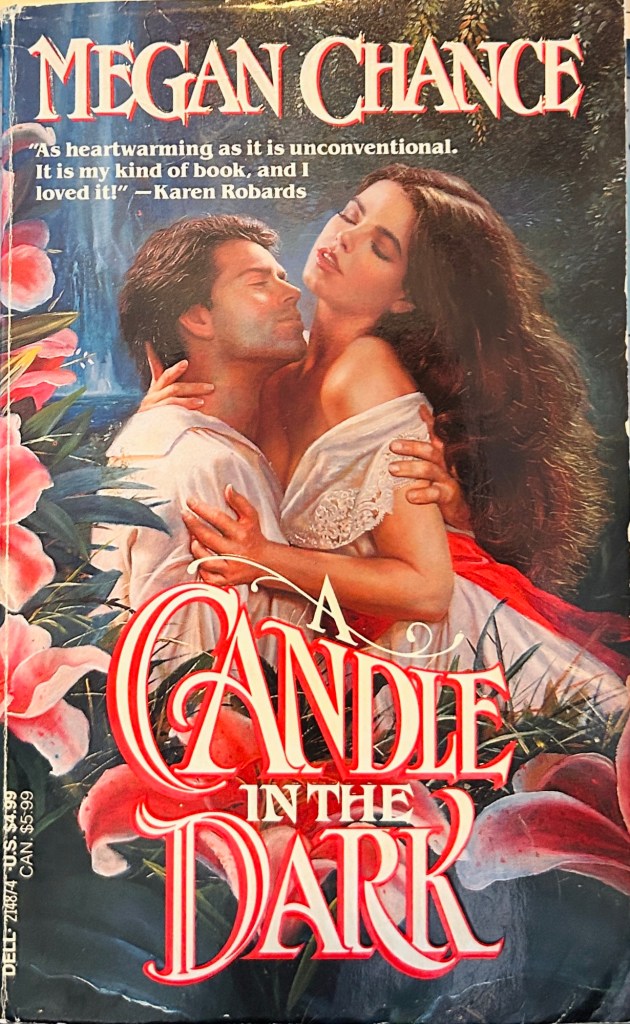
A Candle in the Dark by Megan Chance
New York City, 1849
content notes: sexual assault, alcoholism
Dr. Cain D’Alessandro is in a drunken stupor when a woman with blood on her clothes and a slash across her face bursts through the doors of Cavey Davey’s tavern. The woman is looking for a man willing to pose as her husband on a trek to California by way of Panama.
Ana, the “Duchess”, is a sex worker in need of protection after killing a client who physically assaulted her and refused to pay for her services. This particular client was known to be violent with Ana’s colleagues at the brothel, but, because he was wealthy and politically well-connected, Rosalie, the owner of the brothel, allowed his continued patronage. Ana has to leave New York City immediately to avoid violent retaliation from Rosalie, or worse – a trial that will surely see her hanged.
Ana clenched her hands, again feeling the gummy blood on her fingers. She would never forget the smile on the bastard’s face as he fastened his trousers and announced that she hadn’t satisfied him. He had no intention of paying for his abuse. Rage based through her at the memory, and she quashed it ruthlessly. She’d paid him back in spades.13
Ana chooses to head west to California because, even though she was one of Rosalie’s highest paid girls, it is unlikely Rosalie will follow her that far. Ana has a plan to continue doing sex work in San Francisco where she will have complete control over which clients she sees, “She wanted to run her own house. A place where she could work for a few short months – long enough to make enough money to get out of whoring and live her life her way.”14 Retrieving the money owed her (and more) from the dead client reveals Ana’s strong sense of practicality and her unwavering lack of guilt over what she believes must be done to survive,
she didn’t regret anything. She’d done what she had to do, she was who she had to be. It was time to put it all behind her and go on. Fate had given her the key to her escape, and she would make the most of it, just as she always had.15
Cain is an out-of-practice physician who has seen too much. He spends his days getting black out drunk to avoid thinking of the patients he couldn’t save and the memories of his abusive childhood. Initially, Ana doesn’t want to hire Cain when she learns he used to be a doctor, but she soon realizes there is no other option. Out of money and desperate for his next bottle, Cain agrees he will pretend to be Ana’s husband – so long as she keeps him supplied with money and alcohol.
The owner of the brothel Ana worked for didn’t seem to care that a wealthy, connected man treated her workers poorly, it was more important to avoid drawing attention to her establishment. Ana felt it was unlikely the police or court would believe her story.16 Due to the precarious legality of sex work in many jurisdictions, including the United States, many sex workers, who already face myriad forms of discrimination,17 cannot report being raped, assaulted, or robbed while working because they are at risk of being arrested for selling sex (or the police may not believe their accounts). The legality of operating a brothel or doing sex work in New York City during the time A Candle in the Wind is set is inconsistent: prostitution was illegal yet guidebooks listing the location and pricing of brothels were widely distributed,18 what what was allowed or overlooked likely depended on what neighborhood you worked out of or who you could pay off.19 20 Would her accusations, and those of her colleagues, be taken seriously if she hadn’t killed him? The safest option for Ana is to leave the city.
What happened to Ana, a client refusing to pay, is considered by many in the sex industry to be sexual assault.21 22 A sex worker consents to sex (or other services) with a client when the worker and client are in agreement about price for services. If a client refuses to pay or attempts to negotiate paying less than the agreed upon price during or after a session, the worker’s consent has been violated.23 24 Ana shares this understanding as much in the text, “Their reasons for coming in don’t interest me.” She laughed shortly, a bitter sound without humor. “I don’t care why. As long as they paid for it, I gave them what they wanted.”25
With help from the tavern owner Davey, Ana acquires clothing suitable for a wife so it will be easier to conceal identity. Now aboard the Delilah, Cain and Ana meet Jimene who takes an immediate interest in Ana.26 After eight days on the ship – Cain spends the duration drunk – everyone aboard seems to have bought the husband-and-wife ruse and, to Ana’s surprise, didn’t bother her once, “[Cain] had done his best to initiate that respect. That alone was worth the price of his ticket.”27
Once they reach land, Ana and Cain make way to Panama City with the help of Jimene – at first this arrangement upsets Cain, but he soon realizes they will need help navigating the jungle. The journey through the jungle is one trial after another: multiple ambushes, Ana kills one of the men who attacks them,28 and Jimene is severely injured during one of the ambushes. Cain treats his wounds, diffusing the tension between them.
Later, Cain becomes so intoxicated he can barely walk so Ana, enlists Jimene to help her tie Cain to a tree in order to dry him out. Cain’s forced sobriety is a terrible, painful experience – when he pleads for a drink Ana refuses and Cain threatens to tell everyone she is a “murdering whore.”29 When Cain begins to sob after experiencing hallucinations of his late mentor, who died while Cain was performing surgery on him, Ana holds him and tells him he’s not alone and she’s not going away. After six days tied to a tree, Cain wakes feeling hollowed out. Ana is relieved he’s alive, but disappointed when Cain asks for alcohol; she naively thought his addiction would be cured
Jimene takes the group to his family’s home after learning that his mother, Doña Melia, has been sick. With Ana’s help, Cain treats Jimene’s mother using leeches, quinine, and opium.30 When Doña Melia’s fever finally breaks, Ana begins to show signs of the same illness. Jimene and his family help Cain care for Ana. She’s more vulnerable here than she’s been in the entire book, but information is not pried out of her, nor does she reveal anything about her past to Cain while he’s taking care of her. Once she recovers, Ana and Cain attempt to make a cake for Jimene’s family but they hilariously fail.
When they finally make love Ana and Cain both experience a crisis over Ana’s past: Ana feels dirty and empty and Cain begins to question if Ana even enjoyed the sex or if he’s just like a client, “it was ironic, he thought, that the one woman who made him feel worthy was a woman practiced at artifice and lies.”31 In the context of a romance, transactional or meaningless sex complicates the purpose of sex scenes: the sex between characters must do the work of bringing them together (physically and emotionally) while moving the plot forward. In romance, the sex is imbued with a specialness that has the power to change characters for the better . . . if they are having it with the right person.32 I think sex work challenges this specialness – ideas about morality, identity, and authenticity are brought into question. For their substack, Sexy Lamp Test, Edie Montana writes,
what does sex work stand for? Sex work is a job, but it is also a political act and sex workers’ bodies carry political messages. It goes against social norms on sexuality that morally exclude the possibility of turning sexuality into a transactional and commercial act. It upsets gender roles, that, for example, frown upon women who express types of sexualities that don’t conform the standards and ask them to dedicate their bodies exclusively to a partner in a monogamous relationship – and if they don’t, they will be punished with the worst label a woman could think of, the label of the “whore”.
Ana’s fears about falling in love, and her confusion over who she is if she isn’t the Duchess, overwhelm her. Cain does return to his senses but his attempts to reassure her that the past doesn’t matter and that he loves her, she tells him she doesn’t know if she can love him back, “he didn’t know what to say to her. They were the saddest words he’d ever heard [ . . . ] He loved her enough for the both of them.”33 Ana abruptly leaves after getting Jimene to tell her directions to Panama City. When he learns Ana left, Cain decides not to chase after her, he knows that doing so will only push her away from him.
Privacy as a Grand Gesture
The major conflict between Ana and Cain is Ana keeping parts of her past private. I think Chance makes thoughtful (and sometimes thorny) choices with regard to sex work and privacy in this work. Background information about both characters is slowly revealed as the book progresses: we learn about Cain’s traumatic upbringing and how the physician he practiced under died unexpectledly.We learn Ana is the illegitimate daughter of a Russian aristocrat (Cain notices that her way of speaking and moving through the world suggests a cultured upbringing). Later, we find out the reason she distrusts doctors, and was initially reluctant to hire Cain as her protector after she learned he was a physician is because when she was younger, a doctor who was supposed to care for her sick mother raped Ana. This information is disclosed through flashbacks for the reader’s benefit, however the memories are not immediately shared between the characters. As they spend more time together and Cain becomes sober, he wants to know who Ana really is and why did she work in a place like Rosalie’s?34
Ana asks Cain about the names (Rafael and John) he called out while he was detoxing from alcohol but he is resistant to share who John is, instead he insists she share information about herself. He eventually tells her his full name: Cain Rafael D’Alessandro but when she again asks who John is, he crudely says, “How did you become a whore.”35 This tense exchange happens after Cain has been forced to quit drinking and has gone through a horrifying withdrawal. In this moment, he’s acting out in a way that is unusual for him but he knows it will hurt Ana, and it does, “his response was so quick it unnerved her. Involuntarily Ana stepped back, trying to hide the uncontrollable panic his words sent rushing over her [ . . . ] There were some things it was better if friends never knew.”36
Prior to this low moment – and then later in his recovery – Cain wants to know more about Ana. In chapter seven Cain pointedly asks her, “How did a girl like you end up in a brothel in Five Points?” During this exchange, she remains unfazed by a stranger’s rude question, Ana is not embarrassed by her work, rather she doesn’t believe she owes anyone an explanation of the conditions that lead to her entering sex work, “what is it you really want to know, D’Alessandro? Do you wonder how I can bring myself to sell my body? How I can demean myself so much? [ . . . ] Let me enlighten you. It’s not demeaning. Demeaning is working your fingers to the bone doing other people’s laundry and still not having enough to eat.”37
Cain’s growing sense of entitlement to this information is not always out of curiosity or to know her intimately as a friend would, but to have power over her. And Ana recognizes that this knowledge of her past makes her vulnerable, “she was too afraid of revealing something that could be used as a weapon against her, too afraid of being indebted.”38
By chapter seventeen, Cain and Ana have grown closer – he’s helped her flee Five Points and she took care of him while he was detoxing. After Jimene asks him to help treat his mother’s fever, Cain spends time thinking of his mentor, Dr. John , and he remembers that it’s been three years since he practiced medicine sober. Ana finds him alone and asks if he’s alright. Cain tells her about John and how he died as Cain was performing surgery on his infected leg. Once again, Cain asks Ana pointed questions about her background, he wants to know where she came from. When she says he already knows she lived at Madam Rosalie’s for a while, he pushes for more:
“Did you like it there?”
“It was one of the best houses in the city. I was lucky to be there.”
“That’s not what I asked you.”
“Yes, it is.” She frowned, her brown eyes lit with confusion. “You asked me if I liked it there.”
“You didn’t answer me.”
“But I did. I told you —”
“Did you like it there, Ana?” [ . . . ] He could almost see the wheels turning in her mind, the agile way she searched for an impartial answer to his personal question. He wasn’t sure what he would do if she answered him that way [ . . . ] or even why he wanted so desperately to know about her.
Ana says she doesn’t understand what he wants from her, but this response only upsets him further, “Did you like it there or not? How goddamned hard is it to answer? ‘Yes, I liked it’ or ‘No, I didn’t.’ Christ, Ana, what the hell is wrong with you?”39 A while later, Ana approaches Cain and tells him she didn’t like living at Rosalie’s and that every day she was there she wished she were anywhere else.
So, Cain finally gets a response he thought he wanted – Ana tells him she did not like working at Rosie’s. But at what cost? We know Ana didn’t have a good relationship with Rosalie and I wonder if she revealed this information to Cain in this way to put an end to Cain’s incessant questioning (notice Ana elides telling him why she ended up working there)? In their article Cash/Consent for N+1 Lorelei Lee writes, “again and again in my own life, people have demanded to know what has been done to me, how I was exploited, what kind of trauma or poverty pushed me into believing I had no other options than to trade sex. Or they have asked to hear about how trading sex has been my pathway to empowerment, to sexual adventure.” People expect sex workers to have traumatic backstories and hate their work because it supports the bias that only traumatized people do sex work. And these same people then feel they are owed lurid details as a condition before extending empathy.
It’s not until almost the end of the book that, as Ana begins to struggle with her identity (is she Ana or the Duchess?) and her future (stay with Cain or go to San Francisco?), Cain finally realizes what’s at stake. His questions about her past are not only pushing her away from him but are hurting her, “she was confused and uncertain, and for the first time since he’d known her, she wasn’t even hiding it very well. [ . . .] Then he realized it was more than confusion she felt. It was fear. She was afraid. The knowledge took his anger,”40 ( emphasis mine). He lets go of his need to know why, and in the book’s grand gesture, Cain accepts that he does not need to know everything about Ana to love her. Maybe she eventually tells him more about her past, maybe not, readers are not privy to this moment. I do think it is romantic to be known and to know, yet Cain is taking the ultimate romantic risk in choosing to be with someone he may never fully know. To be known, or to reveal, are important tenants of romance, right? Once a character has disclosed all and has been laid bare, they will be accepted by their love interest. But A Candle in the Dark offers a compelling alternative – your past may not ever be fully revealed, but you are accepted anyway:
what had she said? You expect too much. I can’t give you what you want. [ . . . ] “Ana,” he said slowly. “I don’t care about your past.” With shock, he realized the words were true. The questions that had once seemed so important – why she became a whore, why she hated doctors – didn’t matter anymore. “I don’t care.”41
A more extreme example of a hero’s desire to know the heroine can be found in Patricia Gaffney’s To Have and to Hold. Rachel Wade has been released from prison after serving a ten year sentence for murdering her husband. Requirements of her release are that she work and remain housed, but since her release Rachel has not been able to find work and has no place to live. Now, she is being tried for vagrancy by the local magistrate. The hero, Sebastian Verlaine, Viscount D’Aubrey, sits on the panel deciding if she is to be re-jailed. Suffering from a severe case of aristocratic ennui, Sebastian takes a prurient interest in Rachel and offers to hire her to be his housekeeper. Everyone understands the reason he offers her this position; Rachel assesses her options and agrees to work for him.
Once Rachel is living in his home and working for him, Sebastian begins asking her questions about her husband’s death, hoping she will reveal salacious details. But, as Angela R. Toscano writes, “she is frustratingly silent. Rachel is repeatedly characterized as a ‘non-entity’ (22) as a ‘blank’ (20, 42): ‘Mrs. Wade has simply wasted herself’ (24). It is this blankness, this erasure of self that Sebastian finds compelling. From the moment he sees her, he must know her.” Sebastian’s rape of Rachel is bound with his desire to know her. Cain doesn’t rape or threaten to hurt Ana, but, at times, his pursuit of knowledge about her mirrors Sebastain’s arc. For both Cain and Sebastian, their desire to know dissolves once they fall in love and accept they are not owed information; Rachel and Ana’s choice of when and how to reveal their history (or not) is more important.
The book has a second grand gesture at its close: Ana has left Cain behind and is on a dirt path to Panama City; it’s getting dark and she’s scared. Ana notices no one is coming after her; it is here that she realizes staying with Cain (and Jimene and his family) would be good for her, she could be happy with him; maybe they could have a family. She’s suddenly so tired and she doesn’t want to keep running away. Ana cries and then heads back to the farm. When she returns, Cain is sitting with one of Jimene’s nephews, Enzo, “he did not expect to see Ana, though he had been waiting for her [ . . . ] she looked tired and worn and so damn beautiful it made him weak [ . . . ] she was back but he wasn’t sure what that meant.”42
Ana tells Cain she loves him and that she can’t be the Duchess again, even if she left Cain for good; she says she’s not that person anymore. To me, this works as a subversion of a popular romance plot wherein a heroine runs away with no resources, no plan and ends up in peril so the hero will have to save her. I don’t think that is a bad plot, rather I commend Chance for trying something different here. Ana leaves Cain, he understands that he can’t chase after her, he must trust her to find a way back to him. When she does return to him it’s because she wants to, not because she needed to be saved or because she had no other options.
The entire book is basically Cain and Ana in close proximity – which is why the somewhat abrupt ending (at least by today’s standards) doesn’t bother me. Like, we know how they will navigate conflict as a couple – they’ve been with each other at their absolute worst, together they’ve helped care for friends, they even tried (and failed hilariously) to bake a cake! I think Cain choosing to respect Ana’s privacy, and, in return, Ana choosing to stay with Cain are deeply romantic acts made by two flawed people who are, at last, open to love and being loved.
Chance subverts another popular plot: a romance heroine posing as a sex worker who is found out because the hero can tell there is something different or special about her (see: Gentle Conquest by Mary Balogh, The Courtesan Duchess by Joanna Shupe, The Raven Prince by Elizabeth Hoyt).43 Characters in these books are not doing actual sex work, as in screening clients and mitigating risks, rather they are having sex with men they know under the guise of being a courtesan or brothel worker. Their status or family background eventually surfaces and the ruse is found out. They weren’t real sex workers, isn’t it obvious?
Ana is the illegitimate child of an aristocrat. She did not grow up with access to the aristocracy; rather, her mother taught her speech and manners of the upper-class to effect an air of nobility. Later, working as the Duchess (and when she devises a financial plan for San Francisco) Ana is able to charge more because of this performance of class drag.44 By the end of the book, there is no secret inheritance, Ana’s status is not elevated to an Actual Lady; and Cain is not revealed to be an English Duke or whatever. Ana chooses to stay with him and they will both have to work (as in jobs) to make a living together.
Identity
By the end of A Candle in the Dark, Ana goes through the motions of questioning her identity – who the “real” Ana is: is she the Duchess or is she Ana? She cannot be both, she must choose one over the other. Sex workers in romance are frequently made to bifurcate themselves, not unlike sex workers in the real world: their “real” identity vs. their identity as sex workers as Olivia Hunter Willke explains, “transformation, the delineation between selves, is something most sex workers can relate to. ‘The act of embodying while not being in the body is an intractable part of being a whore’ said anon [ . . . ] ‘Wholeness vs. well packaged parts, which is most attractive?’”
This is a problem for the sex worker character in romance because the genre must reconcile sex workers using genre conventions: the sex worker reveals their back story – the why or how they became sex workers – and then, after falling in love, they accept their better self (the self that no longer has sex for money). Near the close of the novel, Cain no longer thinks of Ana as a whore; she’s just Ana. In this way, A Candle in the Dark is like most popular romances in that it ends with Ana, a sex worker, leaving sex work and abandoning her inauthentic self, the Duchess. When compared to romances featuring a bookseller or lady trouble-maker, the characters in those novels are considered special, feminist, experts, etc., because they have an occupation. This understanding does not extend to sex work: the person that’s into fossils (or whatever!) will continue to do this work (sometimes even for free!) and the love interest will ultimately always find this occupation valid and worthy of respect. Sex workers are often expected to struggle with their identity and then sever their livelihood before they can be happy.
Duality is a major theme in Mary Balogh’s Slightly Dangerous. Consider Wulfric Bedwyn, Duke of Bewcastle: he is at once a man and the Duke; they are the same person with distinct roles. He explains as much to his love interest, Christine, after she puts into question who the real Wulfric is, “you accused me a few evenings ago of wearing a mask, and you were wrong. I wear the mantle of Duke of Bewcastle over that of Wulfric Bedwyn, but both mantles are mine. I am not less of a man because I choose to put duty first in my life.”45 Christine comes to love and accept the man and the Duke.
The decision for a sex worker to exit their work, made by one character, in one romance novel isn’t necessarily bad or wrong! Individually, it may not seem so significant, but when I account for the romances I’ve read where sex workers stop doing sex work by the end of the novel, that they usually leave the industry entirely is the accepted (anticipated) conclusion? Just thinking about a few historical romance novels I’ve read and enjoyed, that all end similarly: in His Lordship’s Mistress (HLM) by Joan Wolf and A Gentleman Undone (AGU) by Cecilia Grant the mistress characters exit sex work by the end. Like Ana, Jessica (HLM) and Lydia (AGU) had exit plans at the beginning of the novels. In The Duke by Galen Foley, Hawk proposes to Bel at the end of the novel. Every Mary Balogh romance that features a mistress character ends with them as wives (or engaged). I could keep listing examples. . .
Working women often do not leave their occupations – as frivolous as some may be, especially when considering the salary (or lack thereof) – by the end of a romance novel. . . unless they do sex work. At the outset of the novel, Ana had an exit plan – she anticipated she could increase her prices in San Francisco owing to her ability to appear as a lady – this act of refinement was sure to increase her savings. Once she saved enough money to live comfortably, she could retire. Again, I do not think this is inherently poor storytelling. But the frequency of this authorial choice in genre romance does make me question what this signifies for the genre?46 For me, it’s not about a character being a strong, independent woman, or having self-respect thus she has a career; rather, it’s about normalizing a character doing sex work at the end of a romance novel at the same frequency as any other occupation.47
Although A Candle in the Dark ends like many other romances featuring sex workers – with Ana leaving sex work for good, Chance makes compelling decisions regarding Ana’s personal code, bodily autonomy, and her privacy.
I’ve done sex work but I am not the authority on sex work and I don’t speak for all sex workers; my thoughts and opinions are my own. I’ve read a lot of genre romance, and I find it difficult to not notice how the genre views sex work/ers – within the novels themselves and how authors and readers speak about sex work/ers. . . or where sex work and sex workers are excluded from genre conversations on work or bodily autonomy. This essay is my attempt at redirecting the conversation.
research notes:
- I mentioned this project in a footnote, but I want to make sure folks know about and support Delilah Saul and Em Vaughn’s upcoming film project, Seeing Red: https://seedandspark.com/fund/seeing-red-anti-sex-worker-bias-in-the-media
and you can subscribe to their substack here: https://outlawmediacompany.substack.com
- In developing this essay, Lauren Kirshner’s Sex Work in Popular Culture proved to be useful.48 Kirshner’s book focuses on sex work in film and television, drawing on labor and feminist theory; her essays provided much-needed guidance as I was unable to locate corresponding romance scholarship. Writes Kirshner, “sex workers have long been a fixture on screen because they are such compelling and controversial figures, embodying both desire and danger, power and vulnerability. In fact, more actresses have won Oscars for playing sex workers than for any other role.49 During this time, popular culture contributed to this stigmatization by recycling stereotypical images of the sex worker as a fallen woman or a femme fatale, her amorality, fragility, and disposability her main features.”50 As with most popular media, genre romance often relies on these same harmful stereotypes when telling stories about sex workers. However, this is not always the case as there are romances (from all eras, throughout the subgenres) featuring empathetic portrayals of sex workers.
- Ana’s fictional account in A Candle in the Dark is not an uncommon experience for sex workers in the real world – issues of under or non-payment are prominent in both criminalized and decriminalized jurisdictions.51 In Voicing Consent: Sex Workers, Sexual Violation and Legal Consciousness in Cross-National Contexts, the authors conducted surveys and interviews with over 400 sex workers, across multiple countries and within various legal environments to survey, “victim-led definition of consent and harm . . . examine the dynamics between different legal contexts . . . and explore the extent to which the legal context affects sex workers’ actions, perceptions, understandings and experiences of sexual violence and unwanted contact.”52 Respondents from each jurisdiction understood non-payment as a violation of their consent.53
Writing for The Guardian in 2018, Michael McGowan and Christopher Knaus, reported on multiple cases of fraudulent consent, or payment evasion, experienced by sex workers in Brisbane, Australia. They write, “In some jurisdictions, courts have found that when a person cons a sex worker – refuses or evades the agreed payment for sex – such acts constitute rape, because consent for the sexual act was obtained fraudulently.” Gabrielle, one of the sex workers interviewed for The Guardian, said, “in my mind, payment equals consent and if you take away the payment I wouldn’t be consenting to having sex with him.”
For sex workers using online platforms, such as OnlyFans, it is not uncommon for the workers to experience chargebacks. A chargeback is when a client pays for a subscription to a content creator’s page, or buys content, then deletes their profile or disputes the charge to their credit card company after viewing the content. Writing for the International Journal of Gender, Sexuality and Law, Bianca Bebbe explains, “chargebacks in the sex industry are particularly interesting because they demonstrate how both stigma and discriminatory sex work laws create the conditions for sex workers’ vulnerability. Swartz says a low-risk business will usually have less than 1% of their sales result in chargebacks, whereas “according to some industry estimates, the rate of chargebacks in relation to total transactions for adult – services merchants can be as high as 4%” (Swartz, 2020, 95).” https://journals.northumbria.ac.uk/index.php/ijgsl/article/view/1258/1621
- Earlier this year, Felicia Davin wrote about A Candle in the Dark for their newsletter. Although our opinions about the ending differ, I appreciate their review!
- Why So Many Sex Workers Love David Lynch by Olivia Hunter Wilke Hunter asked sex workers about media that portrays them – what a concept!
- Breaking Stigmas: Elly Clutch Talks Purity Culture and Empowerment from Holly Randall Unfiltered; I like this interview – Elly talks about her work making porn. I’m only interested in hearing about what is and isn’t pornography from people who make or perform in porn, the rest of you sound like a bunch of dorks.
- I think everyone should read Bad Attitudes on Trial: Pornography, Feminism, and the Butler Decision by Brenda Cossman, Shannon Bell, and Lise Gotell especially if book bans and online censorship upsets you.
- Rereading Naked in Death made me appreciate what Peter Raleigh writes about Ridley Scott’s 2001 film Hannibal, adapted from Thomas Harris’s novel of the same name. Clarice Starling’s professional life has been on a slow decline in the decade after her success in Silence of the Lambs. She has been stuck in unfulfilling roles within the FBI, the bureau appreciating her, “elite capacity for violence,” but little else. This is in such bleak contrast to her earlier aspirations to work in the Behavioral Health division under the mentorship of Jack Crawford. I love Raleigh’s analysis of Hannibal, pointing out that the film understands that a career in law enforcement can only warp one’s sense of justice. This, writes Raleigh,
is what the FBI makes of a bright young woman’s dreams of saving lives; the Bureau, the state, needs hardened killers more than it needs self-assured female investigators who want to do the right thing. The repeated spectacle of Clarice, acting always in “self-defense,” dealing out death to representatives of American society’s most marginalized groups defines her career, and on some level Hannibal knows it: where Silence pitted Clarice against what could—infamously, and despite the film’s superficial protests—be understood as a monstrous representation of trans womanhood, and made a kind of triumph of her victory, the sequel reintroduces Clarice by thrusting her into an armed confrontation with an HIV-positive Black woman holding an infant, and makes an effectively career-ending misery of her “success” in the gunfight that follows.
This post would not have been possible without help from my friend Beth, who gave me much-needed feedback throughout the writing process. almost a year ago, I was really struggling to write anything. When I told Beth about the lack of romance scholarship available to me, she immediately offered support and had the sense to recommended I look to other disciplines. I cannot stress this enough – all of my ideas would have remained half-baked and incoherent, confined to scribbles in my notebook, if not for her guidance. “Thank you” feels woefully, embarrassingly inadequate. Beth, you deserve everything! (I’m not crying.)
Works Cited
10 News. “Refusing to Pay a Sex Worker Could Be Considered Rape in NSW | 10 News+.” YouTube, 16 Mar. 2026, www.youtube.com/watch?v=J70N7hn0CFQ.
Balogh, Mary. Slightly Dangerous, ebook, Delacorte Press, 2004.
Beebe, Bianca. ‘“Shut Up and Take My Money!”: Revenue Chokepoints, Platform Governance, and Sex Workers’ Financial Exclusion’ (2022) 2 International Journal of Gender, Sexuality and Law 140.
Bickers, Matilda, et al. Working It: Sex Workers on the Work of Sex. PM Press, 2023.
Chance, Megan. A Candle in the Dark, ebook, Megan Chance, 2011.
Hill, Marilynn Wood. Their Sisters’ Keepers: Prostitution in New York City, 1830-1870. Berkeley: University of California Press, 1993.
Hunter Willke, Olivia. “Why So Many Sex Workers Love David Lynch.” Autostraddle, 13 Mar. 2025, www.autostraddle.com/why-so-many-sex-workers-love-david-lynch/. Accessed 15 June 2026.
I Hate My Job: Thots on Labor, Sex Work, and Capitalism. edited by Adrie Rose, et al, Working Girl Press, 2026.
“International Committee on the Rights of Sex Workers in Europe (ICRSE).” Global Network of Sex Work Projects: Promoting Health and Human Rights, https://www.nswp.org/sites/default/files/Exploitation%20Report%2C%20ICRSE%20-%0Ma%202016.pdf.
Kirshner, Lauren. Sex Work in Popular Culture. University of Toronto Press, 2024.
Kramble, Jayashree. Creating Identity: The Popular Romance Heroine’s Journey to Selfhood and Self-Presentation, ebook, Indiana University Press, 2023.
Lee, Lorelei. “Cash/Consent.” N+1, 24 Sept. 2019, https://www.nplusonemag.com/issue-35/essays/cashconsent/. Accessed 12 Jul. 2026.
McGowan, Michael, and Christopher Knaus. ““It Absolutely Should Be Seen as Rape”: When Sex Workers Are Conned.” The Guardian, The Guardian, 12 Oct. 2018, www.theguardian.com/australia-news/2018/oct/13/it-absolutely-should-be-seen-as-when-sex-workers-are-conned.
Rose, Adrie. “Thoughts on Class Drag, Active Length, Square French Tips, and Red (Spray Paint) Bottoms.” Tryst.Link Blog, 22 Nov. 2023, https://tryst.link/blog/class-drag-square-french-tips-and-red-spray-paint-bottoms/. Accessed 15 Oct. 2026.
Sanders, Teela et al. Voicing Consent: Sex Workers, Sexual Violation and Legal Consciousness in Cross-National Contexts, ebook, Palgrave Macmillan, 2025.
Sexy Lamp Test. “Sex Workers Subvert Norms . . . And Society Punishes Them.” Sexy Lamp Test, 24 June 2026. https://ediemontana.substack.com/p/sex-workers-subvert-social-norms.
“Sex Workers in Research Study Call for Greater Legal Protections against Sexual Violence.” Phys.Org, 10 Mar. 2025, phys.org/news/2025-03-sex-workers-greater-legal-sexual.html.
“Sex Workers’ Rights.” Amnesty International USA, 30 June 2023, www.amnestyusa.org/issues/gender-sexuality/sex-work-rights/.
Smith, Molly, and Juno Mac. Revolting Prostitutes: The Fight for Sex Workers’ Right, ebook, Verso Books, 2018.
Toscano, Angela R. “A Parody of Love: The Narrative Uses of Rape in Popular Romance.” Journal of Popular Romance Studies, Apr. 2012, https://www.jprstudies.org/2012/04/a-parody-of-love-the-narrative-uses-of-rape-in-popular-romance-by-angela-toscano/.
Yamin, Rebecca. “Wealthy, Free, and Female: Prostitution in Nineteenth-Century New.” Source: Historical Archaeology, vol. 39, no. 1, 2005, pp. 4–18, files.commons.gc.cuny.edu/wp-content/blogs.dir/8305/files/2019/07/Yamin-2005.pdf.
Footnotes:
- In Mass Market Romance: Pornography for Women is Different Ann Barr Snitow Snitow read a handful of Harlequin romance novels and claimed all romances are pornography for women.
Alison Assiter argues in“Romance Fiction: Porn for Women?” that romance novels are porn written by women but are essentially the same as pornography made for men: both kinds of media are bad for women because they depict women as subservient to men.
Jonathan A. Allan writes in his paper Softcore romance: on naked heroes and beefcakes in popular romance novels that calling romance porn for women diminishes the genre by associating it with hardcore sex; instead he proposes a degrees system to evaluate depictions of sex and the body in romance novels (the og pepper star rating system?? I think employing any kind of sex rating system for romance novels, still quite popular with readers across book review sites, social media posts, etc., is Not Good and reminds me of a sort of accidental MPAA).
In Sexual #Warfare? Clinch Covers, Stepbacks, and Historical Romance Novels in the Wake of the Golden Age of Pornography Bailey Van Den Heuvel analyzed mainstream pornography from the 1970s and 1980s alongside historical romances released during the same time. Van Den Heuvel argues historical romance rose in popularity as women sought media focused on their stories and pleasure as there was less objectification of women in historical romance than in mainstream pornography.
In Feeling Judged: Reflections on Pornography and Romance from a Minotaur Milking Farm by Laura Vivanco , Vivanco does a close reading of one romance novel, C.M. Nascosta’s Morning Glory Milking Farm, evaluating the relationship between romance and pornography by the explicit depictions of sex in a work of popular culture. ↩︎ - Lauren Kirshner writes about the binary “is it good or is it bad” in feminist thought on sex work in her book Sex Work in Popular Culture ↩︎
- I am biased seeing as I firmly believe, to quote Mike Stabile, “porn and erotica are important and societally valuable forms of speech, and the defense of them in the face of state and church attempts at repression, is a necessary political act.” ↩︎
- My scholarship nemesis (author considers herself an antiporn feminist): https://www.tandfonline.com/doi/full/10.1080/23268743.2025.2569337 ↩︎
- https://www.mindymcginnis.com/blog/everett ↩︎
- I swear, every week a version of this type of “romance is NOT porn” post appears on my feed: https://www.instagram.com/p/DTpyA7UDNuC/?img_index=1
https://www.instagram.com/p/DdcAaapmv29/?exln=bTBxMGRkaXVpODFr
https://www.instagram.com/p/DeQmDcIlT_l/?rpxt=aGU4ZGt2MTRuMmlu
this preoccupation romance readers and authors have with pornography reminds me of that Regina George meme, “why are you so obsessed with me?” (if you answer, “because non-romance readers keep comparing the genre to porn!” I’m not going to hold your hand as I say this: get a real problem!) ↩︎ - more thoughts here ↩︎
- Delilah Saul and Em Vaughn’s upcoming film project, Seeing Red, focuses on media bias and sex work, “Our film confronts two major recurring problems in media (mis)representation: The conflation of sex work with “human trafficking” and the genre of “true crime . . . For over a century, the American media has weaponized headlines, Hollywood, and true crime to dehumanize and exploit sex workers. We refuse to be props used by newsrooms, film studios, and content creators that profit by playing into deadly stereotypes about us.”
please consider supporting this project:
https://seedandspark.com/fund/seeing-red-anti-sex-worker-bias-in-the-media ↩︎ - Kramble, ch. 3. ↩︎
- In her chapter on citizenship, Kramble writes about Annique, a French spy from The Spymaster’s Lady by Joanna Bourne. Annique often wears a disguise during her missions, “sophisticated” courtesan being one of these disguises. Annique recalls the English spies, other women, who had sex to gather information… however Annique never had sex for money or information, her disguise remained strictly performative. ↩︎
- previously, I wrote about the mistress character in historical romance here, here, and here. ↩︎
- Sage, 251. ↩︎
- Chance, ch. 1. ↩︎
- Chance, ch. 3. ↩︎
- Chance, ch. 2. ↩︎
- Although wealth and connections were/are not requirements to evade consequences of violence against sex workers, as evidenced by the real life case of Helen Jewett, a young sex worker living in New York City, who was murdered in her sleep by a client. During the murder trial, multiple sex workers from the brothel Jewett worked out of gave eye witness testimonies, identifying the client as Jewett’s assailant. The judge, in agreement with the defense, said that the women could not be trusted due to their status as “persons of ill repute”, and instructed the jury to not use the testimonies in deciding a verdict. The client was found not guilty.(Hill, 172). ↩︎
- “The criminalization of sex work infringes upon the rights of those consensually engaging in this line of work. More specifically, sex workers face barriers when it comes to exercising their rights to: privacy, bodily autonomy, freedom from violence or discrimination. In addition, sex workers often face difficulty accessing health, legal, and other social services due to the criminalization of sex work. Sex workers with intersecting identities face compounding discrimination on the basis of their gender, sexual orientation, race, caste, ethnicity, migrant or other statuses.” https://www.amnestyusa.org/issues/gender-sexuality/sex-work-rights/
↩︎ - Hill, 31. ↩︎
- Yamin, 8. ↩︎
- New York City police organizations of the nineteenth century operated somewhat differently from our twenty-first century understanding of policing: New Yorkers, wary of any military-like policing due to their recent history with British rule, opposed a permanent police force. Instead, they relied on informal, community-based policing, which was inefficient and led to, “unchecked informal discretionary police power,” (Hill, 146).
↩︎ - “Violations such as non-payment and “stealthing”—non-consensual condom removal—are widespread: 76% of survey respondents who had experienced an incident reported a payment issue, while 44% had experienced stealthing. Many workers viewed these acts as violence, yet legal recognition and enforcement vary by country,” (Phys.Org). ↩︎
- “Not paying a sex worker could now lead to rape charges in New South Wales after a landmark case reshaped how consent is interpreted under the law.” https://youtu.be/J70N7hn0CFQ?si=hfaNLQSV-ooJSoci&t=157
↩︎ - Sanders, et al. ↩︎
- according to ICRSE’s community report, Unfair Labour Arrangements and Precarious Working Conditions in the Sex Industry, “Most of the ICRSE members consulted considered sex worker – client relationship as a pre-agreed and consensual contract between service providers, i.e. sex workers performing sexual or intimate labour, and service receivers, i.e. clients. Violations of the contract between sex workers and their client or disregard for the mutually agreed services or fees to be paid by clients (e.g. refusal to pay) were defined as a form of violence or abuse, rather than labour exploitation.”
↩︎ - Chance, ch. 7. ↩︎
- Megan Chance loves a love triangle. Every book I’ve read by her has one, some with higher stakes than others, but it’s always there. To me, it’s almost always obvious who the characters will end up with but I think she’s adept at employing this kind of conflict in her romances. ↩︎
- Chance, ch. 4. ↩︎
- I know everyone loves to see a heroine shoot the hero, I love seeing a character murder not one but two guys who had it coming. The bar is in hell but I appreciate that sex workers are not blamed for the violence they experience nor are any sex workers responsible for murdering other sex workers in this historical romance novel.
↩︎ - Chance, ch. 14. ↩︎
- I like that Chance opted for period-accurate medical treatments and described the harshness of the elements here. Like, riding a horse makes your body ache! It’s really uncomfortable and gross to sit in wet clothes, detoxing from booze is hell, LEECHES!? Cain does question the efficacy of the leeches but ultimately uses the method because it’s what he knows.
↩︎ - Chance, ch. 27. ↩︎
- *cough St. Vincent from Devil in Winter by Lisa Kleypas (and the iterative ripples throughout the genre). ↩︎
- Chance, ch. 27. ↩︎
- WHY WHY WHY? tax records reveal some women entered the profession as means to earn more money and attain a better lifestyle. While not all achieved these benefits, the potential for economic stability motivated many women, (Hill, 81). ↩︎
- Chance, ch. 15. ↩︎
- Chance, ch. 15. ↩︎
- Chance, ch. 7. ↩︎
- Chance, ch. 13. ↩︎
- Chance, ch. 17. ↩︎
- Chance, ch. 27. ↩︎
- Chance, ch. 27. ↩︎
- Chance, ch. 30. ↩︎
- Would we consider these books a reverse rape of mistaken identity plot as defined by Toscano, “the hero is under the false perception that the heroine is actually someone else,”? In these works, the hero remains under false perception, but their consent is dubious. ↩︎
- Writing for Tryst, Adrie Rose defines class drag as, “appropriating the characteristics of another economic class for social, personal, professional, and/or financial benefit.” ↩︎
- Balogh, ch. 20. ↩︎
- and that is for another post or for someone else to further analyze. ↩︎
- there are genre romances where characters keep doing sex work after the happily ever, they are the exceptions not the rule. I’ve encountered this most often in paranormal and erotic romance: the main characters from Private Eye by Katrina Jackson and Candy by Torrance Sené stay working as cam girls. Logan and Devi keep making adult content in Porn Star by Sierra Simone and Laurelin Paige (I haven’t read any books from the A Christmas Notch series by Simone and Julie Murphy, though I wouldn’t be surprised if characters keep making adult content). Maia is a full service sex worker in Jenny Nordbak’s Her Filthy Rockstar; her and Zane discuss her plans to keep doing this work. iirc, August from The Hellmouth Guardian’s Lover by Adriana Herrera remains a sex worker at the end. Throughout Kathryn Moon’s extended series, sex workers continue to work after the books end. ↩︎
- Huge thanks to Beth for telling me about this book in September 2025 as I was circling the drain. ↩︎
- funny that – Kirshner’s book was written just prior to Mickey Madison winning the Academy Award for Best Actress for her role as a sex worker in the 2024 film Anora directed by Sean Baker. A review of Anora written by Marla Cruz, a sex worker: https://angelfoodmag.com/romance-labor. ↩︎
- Kirshner, 5 – 6. ↩︎
- “full criminalization: a legal model where the sex worker, the client, and third parties (such as managers, drivers, or landlords) are all criminalized,” (Smith and Mac, ch. 5).
“full decriminalization: a legal model that decriminalizes the sex worker, the client, and third parties such as managers, drivers, and landlords and regulates the sex industry through labour law,” (Smith and Mac, ch. 8). ↩︎ - Sanders, et al., ch. 1. ↩︎
- Sanders et al., ch. 3 & 4. ↩︎

