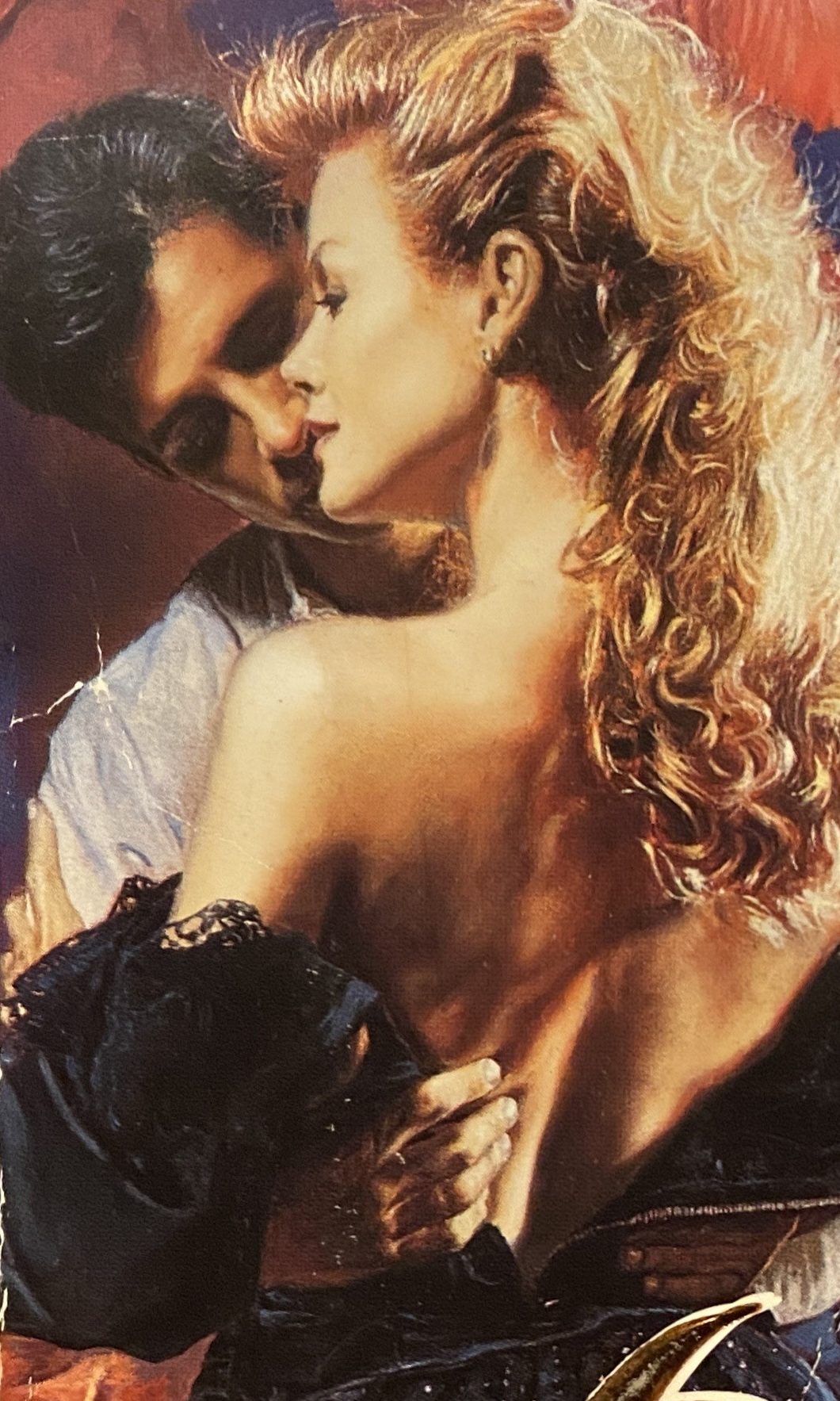
a compilation of books I thought I might include in my mistress in historical romance project. they turned out to not fit well with the project for different reasons but I did feel compelled to write briefly about them. the criteria for my mistress project are romances that include a character as a mistress for the majority of the book – either a sex worker (such as Jessica from His Lordship’s Mistress) or the other woman/person (such as Susanna from Madensky Square). Although Marlowe (A Tempest of Desire by Lorraine Heath) is a mistress, she is not the mistress of the other main character. Kit (Restored by Joanna Chambers) is the kept man of Henry, Duke of Avesbury, for only the first or second chapter. Micha (Never After by Alex Hall) is a sex worker but not a kept man.
Never After by Alexis Hall
2026, Montlake (I received a digital advanced reader copy)
Thomas is a reverend in a small village. Micha is a sex worker addicted to opium and has so much self-loathing it was a difficult to take at times. I understand the appeal of the virgin/sex worker dynamic but I also think the execution within romance is often uninteresting – this is another example of that1.
Thomas’s bishop implies his same sex relationship could be tolerated if Thomas marries a woman to keep up appearances. When Thomas brings this to Micha as a way to be together, Micha becomes upset because he doesn’t want to hide who he is. This felt too easy? There are a few historical romances I started to think about here that I believe worked better, for instance The Phoenix Bride by Natasha Siegel2.
I did enjoy Micha’s journal entries describing his experiences with all kinds of clients: queer men, the night before their marriages to women, having what they tell themselves is one last fulfillment of their desires, or the man whose children are now adults and who has longed to be with another man for years and years; some of the experiences good some bad, some just passing the time.
I loved how Hall wrote Thomas’s character as a man with a calling but is also struggling with his faith. But the struggle is not because he is in love with Micha. After their first sexual encounter, Thomas comes alive with a new understanding of life and love – he cherishes their physical encounters and believes that God has blessed them.
spoilers for the ending of Never After below:
.
.
.
I will say . . . this book has an unusual happily ever after, one that I think about often because of how special it is. I was a little confused the first time I read the ending as there is a sizable time jump between the final chapter and the epilogue. It’s a bit of a jolt to go from two characters negotiating their future to one of them visiting the other’s grave (and with another partner). I think some readers will outright deny this is a romance because they have come to expect a conventional ending where two people end up living together.
In my Goodreads review, I ask what does it “mean” to “be together“? Does it mean characters share a home, a private, physical space? Do they share a family, found or otherwise? Does sharing their lives through letters count if it’s impossible to be together in the same space for long periods of time? I love the choices Hall made here, they are bold and make me believe in what is possible for this genre. Never After‘s ending is what I had expected to see more of with my mistress project. I hope this book inspires other authors to push against arbitrary HEA boundaries that need not be so stridently defended3.
since the release of Never After, Hall has posted questions and answers on their website about if the book can be considered genre romance4
A Tempest of Desire by Lorraine Heath
2024, Avon
One of the most boring romances I’ve read5. Marlowe is a mistress but she is also a lady ballooner because “the air is a place for women where they can think and finally be themselves.” Okay.
A few years prior, Marlowe’s protector tried to use a night with Marlowe in a game of cards with Langdon. Langdon cheated so he would lose and not force Marlowe into something she didn’t want to do. Marlowe thinks Langdon cheated because he isn’t attracted to her. If this sounds familiar, it’s because Cecilia Grant wrote a superior book called A Gentleman Undone. The main character in that book, Lydia Slaughter, is a sex worker whose current protector uses her in a similar situation with Will Blackshear, the book’s love interest. The difference here is that Will does sleep with Lydia and it’s fraught and thorny. It is a choice that asks more from readers and is interested in complicating characters.
Often romances with sex workers as characters – not just historical romance – use sex work/ers as a kind of shorthand for sexiness or eroticism while failing to grasp the politicalness inherent to this kind of character . . . frequently these same romances insist to have an understanding of gender politics. The failure, in these works, to connect the gender with the work with the political continues to baffle. Marlowe and her ballooning are the feminist project but it’s just a preposterous idea lazily executed. The sex work is an afterthought, it is not elevated beyond the reason Marlowe feels bad about guys.
read A Gentleman Undone by Cecilia Grant instead6
Restored by Joanna Chambers
2020, self-published
Kit is the kept man of Henry, Duke of Avesbury. He lives in a townhouse provided by Henry where they meet twice a week for assignations. Henry’s wife is supportive of this7. When Henry must leave London quickly, he arranged a payout for Kit with his man of business. We learn the man of business was embezzling funds from Henry, so Kit was never paid. This left Kit in poverty and caused him to lose his townhouse. Henry has fucked off to the country, unaware of his funds being mishandled and his lover being forced to see violent clients in order to earn back money that was owed him.
I read this because I thought Kit would remain a kept man for more time than the first few chapters. Fast forward eighteen years, Kit now owns a gentlemen’s sex club and a townhouse where he lives with a woman, acting as his sister, and her son.
Henry’s wife has died and his children are grown, he comes back to the city and runs into an acquaintance that also knew Kit. The interaction does not go well and Henry eventually learns about what happened to Kit. Nothing is ever Henry’s fault because he’s a nice duke8. It wasn’t his fault he had to leave Kit’s financial stability in the hands of his man of business instead of taking care of this himself, his wife made him leave town because she was going to die! And it isn’t Henry’s fault Kit never received his settlement, why it was Henry’s man of business who was stealing the funds! Kit doesn’t do sex work (or pay for sex) in the “present” time of the book because of his previous experiences, “he’d vowed when he left the game not to allow money any influence in his bedchamber again, directly or indirectly. Which ruled out anyone he came into contact with at the club.” But this seems like a convenient way to avoid telling a romance about a character who does sex work – or pays for sex – and falls in love9. Again with the bafflement.
- I had a similar reaction to Unclaimed by Courtney Milan. I have messy thoughts about the Milan book – which I do not hate! That character had so much revulsion for her work and began to hate sex – it was a lot to take contrasted against a good, upstanding man who likes himself just as he is. here’s my GR review in which I compare the aspects of the book to the Josh Hartnett film 40 Days and 40 Nights hahahaha (like, why?). ↩︎
- I learned about this book listening to The Reformed Rakes Podcast episode on The Phoenix Bride. I also thought about another book Hall released where the characters are in a lavender marriage, Something Extraordinary (2024). I haven’t read this book however I wanted to point to a work where Hall wrote about this kind of relationship. ↩︎
- ONCE AGAIN I remind myself that I want to write about Katrina Jackson’s Back in the Day which rewired my brain and expanded my understanding of what a happily ever after can be. ↩︎
- as much as I appreciate what she writes here, and I really do because it is how I came to understand the ending . . . I don’t love when authors do this? I know I just wrote a defense of the ending lol but I do think Hall could do with spending less time online explaining their choices and more time editing. ps. fuck the rwa ↩︎
- Heath’s romances are terribly boring. Readers tout her bonkers plots as the draw, but this is overselling the goods. One of her prequel books, the one where the mom dies, was good but since people die it is not considered a romance by readers or whatever. I can’t recall the title atm. ↩︎
- the same goes for Heath’s Waking Up With the Duke skip this and read A Lady Awakened by Cecilia Grant instead! ↩︎
- . . . but I’m not sure if she actually is? Early on, Henry’s wife becomes sick (implied to be breast cancer) and she says the family must immediately leave London. Henry would like to wait to make proper arrangements, but his wife insists they must leave now. Henry agrees and they flee town the next day (the logistics of this does not make sense) ↩︎
- puke ↩︎
- of course, owning a sex club is more acceptable than doing sex work in a romance: owning property is aspirational. ↩︎
 scarr
scarr 