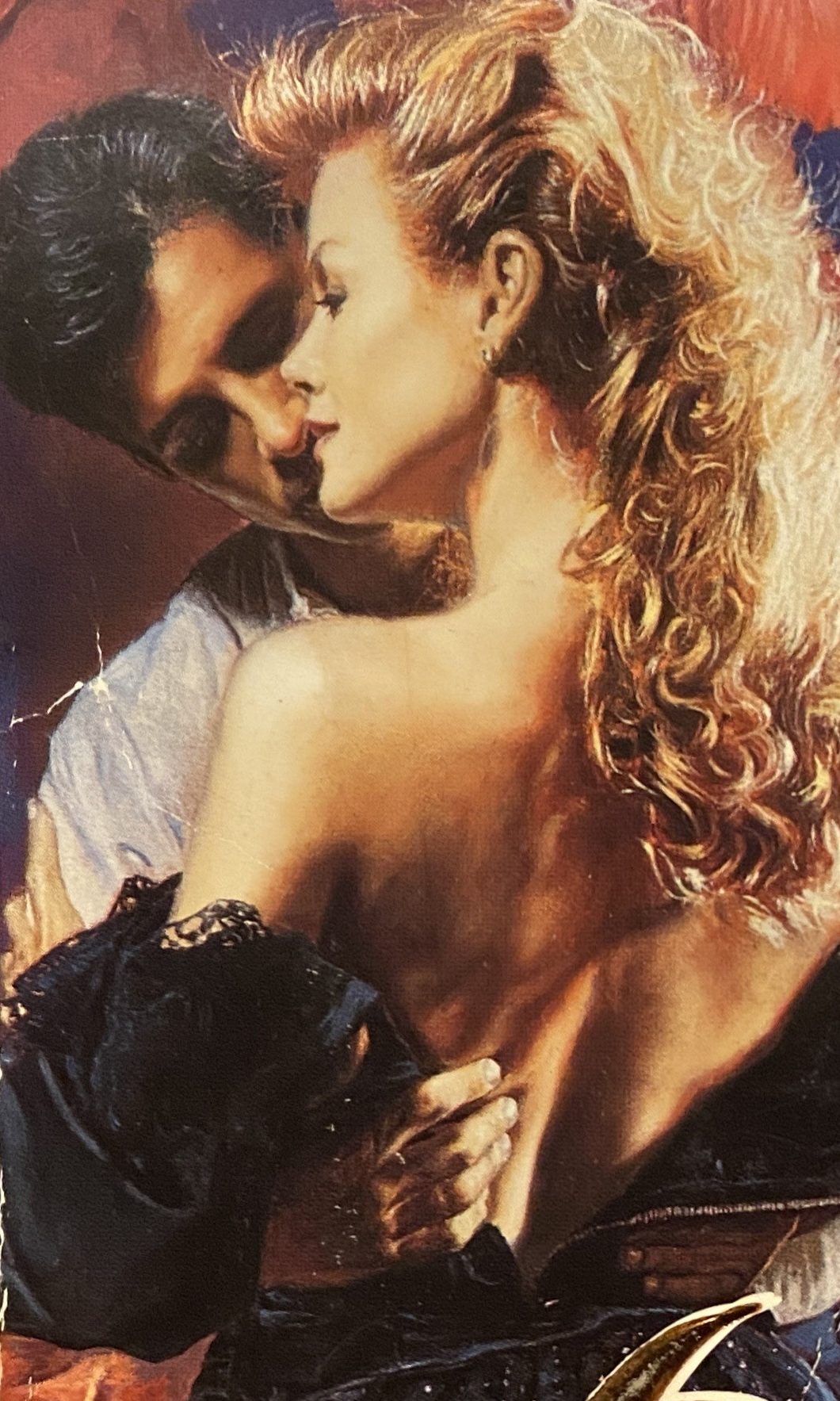
a brief review of Beau Crusoe by Carla Kelly

I referenced Beau Crusoe in my mid-year media update post – here is a review of the book which I first posted to Goodreads last year. What appears in this post has been edited and expanded.
content warning for cannibalism, PTSD
Beau Crusoe by Carla Kelly
Harlequin Historical, 2007
Lt. James Trevenen has come to London to receive a medal given by the Royal Society for his paper on the habits of a species of crab, “The Gloriosa Jubilate: Creatures at Play in a Tidal Pool on a Deserted Island in The Tuamotu Archipelago”. James was able to study the crab in its natural habitat for an extended period of time because, for five long years, he was shipwrecked on an island in the South Pacific. From his manuscript:
Owing to the workings of Divine Providence and none of my own exertions, since I was far gone, my small boat found a gap in the coral reef and grounded me on the sandy beach of my exile. I alone survived.

The ship James was on, the Orion, sank after being split in half after colliding with coral reef. Before sinking, the captain gave James, the last surviving officer, the ship’s log. James and a few other members of the Orion’s crew were able to escape on a small boat; however there was not enough clean water or food to sustain them all.
Seven years ago, Susannah Park eloped to Gretna Green with David Park, her father’ secretary. The young couple then left for India where David contracted cholera and died of fever. His body was burned in a mass funeral pyre. This image haunts Susannah and every autumn, when the leaves and brush are burned, she remembers. Susannah, pregnant with their son, returned to England a disappointment to her family and shunned by the ton. Due to Susannah’s scandalous past, her sister, Louisa, has been unable to find a suitable marriage match.
Everyday, Susannah and her young son, Noah, walk to the Royal Gardens where Susannah paints the flowers brought back from naval voyages. This is where James first meets Susannah (and Noah). James has been invited by Sir Joseph Banks1 to stay with his cousin, Lord Watchmere, Susannah’s father. James and Susannah talk about his manuscript, James tells her that when he first saw the crabs he was so desperate for food he thought about eating them. James explains that on that particular day, he was more lonely than hungry so, instead, he watched the crabs.

When Beau Crusoe was good, it was fantastic (the things we do to survive, decisions that haunt you, the little things James and Susannah do to endure) and when it clanked it was distracting and disappointing (Lady Audley’s characterization, orientalism, the abrupt ending.)
The text doesn’t necessarily take an obvious stand against the British Empire, but it does give readers a glimpse of the brutal realities of expansion.2 While reading this, I often thought of Judith Ivory’s Sleeping Beauty – coincidentally, both MCs are called James and are both the last survivors of their crews, responsible for accounting for what happened; and cannibalism features (differently) in both.
I have a lot of complicated feelings about these books because I do enjoy them however they require more of me than a simple good/bad assessment.3 My opinion of Sleeping Beauty is that, even though I adore parts of it, Ivory did not go far enough in admonishing the British colonial project in Africa, and instead leaned into incredibly racist and harmful stereotypes.4
James’s PTSD from his time on the island is the main focus of the book. Early on, James thinks, “How can I tell you of 1,825 days of solitude, each one spent wondering how I would die the next day, or in a week, or in fifty years without seeing another face?” A theme of the book stemming from James’s PTSD is food and hunger. James, of course, has a complicated relationship with food that Kelly explores in depth:
James awoke to the aroma of sausages. He lay on the narrow settle, hands folded across his chest. There had hardly been a morning on hisses island when he had not woken up dreaming of food. He knew where he was, but the idea lingered.
He opened his eyes, surprised to see the table in front of him spread with sausages and eggs. And there was toast, all soft in the center with butter oozing. He sniffed. He just knew that earthenware pot contained quince jelly. He closed his eyes against the carnality of it all.
He looked around to see the innkeeper bringing out a roast of beef. All steaming and cunningly sliced so the tender, moist, pink interior winked at him like . . . Oh, God, and now he was thinking of Artemisia, Lady Audley with her legs spread wide, eager to seduce him after they left the miserable fever harbor of Batavia
Whenever given the opportunity, James will stuff food in his pockets. Susannah notices this, “when the dinner was nearly done, Susannah noticed Mr. Trevenen deftly pocketing several slices of cheese and a handful of nuts. Does he fear being without food? she asked herself.”
James does not save the food for himself. At night, James attempts to ward off the ghost of a dead shipmate, Tim Rowe, by leaving plates of food on dressers in his room. The encounters with the specter are unsettling and often greusome:
The sound continued and James shuddered. “I know you’re not there,” he said again. His voice was rising, but he could not help himself. He took a deep breath and opened his eyes.
The man was sitting in the chair between the bed and the door, so James could not flee the room. Ragged shirt, ripped pants, his face red, blistered and swollen from nineteen days in an open boat. James’s eyes went immediately to the man’s legs, and there was only one because Tim Rowe had a wooden leg. He was chewing on Walter Sheperd’s arm, making quiet, smacking noises, interspersed with low murmurs of satisfaction.
He seemed to notice James then. The man took the arm from his mouth, smiled with shreds of flesh hanging from his teeth and held it out to James.
James couldn’t help himself. He ran from the room.
what happened on the boat
After getting on the longboat and securing the ship’s record, (as the only surviving officer, James is duty-bound to accurately record events in the log), James attempts to rescue other sailors from the sinking Orion. The rescued men brought almost nothing with them and very little food or drinking water was available. The men, all becoming more ill by the hour with no food or water, agree that the surviving men should eat any who die:
A week later, when Billy Bright, the foretopman, began to hallucinate, and wouldn’t even try to drink his own urine anymore, the four of them held a civilized discussion. The foretopman had no objection to being eaten. “Just wait till I’m gone, lieutenant, that’s all I ask,” he said.
During the next few weeks, one man dies and the survivors eat him with one man, Tim, becoming ravenous. He begins to eat a man who has not yet died. “Rowe had stashed one body in his kingdom at the other end of the longboat. He had cracked the bones for the life-giving marrow, but even Rowe was tiring. James had not heard him cracking any bones lately.”5 Eventually, Tim and James are the only survivors and the boat they are on crashes into a coral reef, mirroring the fate of the Orion. James watches as Tim is devoured by hundreds of crabs.
hunger, opulence, appetite, gluttony
Once James is rescued by missionaries, he meets Lady Audley, a married woman who pursues a sexual relationship with him. She helps pay for his ticket home and James uses the excuse that he has been celibate for those five years on the island for how it was so easy to fall into an affair with her. When he remembers this time on the ship home, he is often ashamed and embarrassed by his behavior – at falling so quickly into bed with a married woman and never bothering to learn more about her beforehand.
I think it’s obvious we are supposed to draw the connection between Lady Audley and Tim, the man haunting James: James begins having visions of Tim’s ghost after he starts having sex with Lady Audley. Both Lady Audley and Tim share bottomless appetites for the taboo but Tim is a ghost and while he was alive, he wasn’t himself on that rescue boat. James even recalls that Tim was good at his job and was otherwise a normal man while they were aboard the ship. It was the sea and hunger that drove him mad.
Lady Audley, meanwhile, is just a slut who has had too much sex, now scorned and dead set on ruining James’s life. Tim haunts James – metaphysically – for what he did to survive (eating human flesh) and Lady Audley haunts James – corporally – for indulging carnally in flesh (recall the passage shared above; James sees meat being cut and thinks of a vulva)
I don’t like the way Lady Audley is written. One would assume she spent all her days and nights fucking men indiscriminately, and then devising evil plans to ruin them once they have moved on from her. I think women can do nasty, mean things and I think that can be on page – so this is not just a case of I don’t like seeing women behave badly. But this is just such singularly poor characterization that I can’t get over it.
Lady Audley had called him James a time or two on that voyage from Batavia. In fact, his disillusion with her had probably begun when, in the heat of thumping, thrusting passion, she had called him Edward a few times and then Clarence. There had even been a “Leonardo” when he had tried something more experimental he had learned from a whore in Lisbon. Obviously, someone named Leonardo had beaten him to that particular position. By then, he wasn’t too surprised.
This stands in such stark contrast to the way Kelly writes about Susannah’s deceased husband, who was by all accounts kind and loved by Susannah, “Her life with David, though brief, would never dissolve from her heart; she did not expect it to.” I know she can do better than this which is why it bothers me so much.
misc.
Kelly’s books may not have descriptive sex scenes but here they are oftentimes unconventional – the first sex scene ends and Susannah is still quite turned on, James says he is spent – signaling p-in-v will not be happening again just yet. He manually stimulates Susannah until she is satiated. A little while later, as the couple are talking and still touching one another, James manually brings Susannah to orgasm. But it wasn’t like the typical “the man did the oral on the woman so a feminism happened” it was just a moment between lovers, partners enjoying one another without any sort of score keeping. I am often bemused that scenes like this don’t happen more often in romance – which often touts “centering female pleasure” as a benefit of reading the genre (when more often, it’s just reinforcing “penetration is king.”) The scene is brief but lovely.6
In Carla Kelly’s romance novels, men are given depth that is not always present in romance novels – what I mean is James is not written in a way where I imagine him as the platonic ideal of a book boyfriend. Kelly’s heroes cry. In almost every romance I’ve read by her, there is a scene where the MMC is overcome with emotion and cries. It is not a weakness to be brought to tears by sadness, frustration, or confusion in Kelly’s romances rather it is human:
She leaned closer to him, and took his face in both her hands to capture his attention. “James, there is plenty of food on this island. There’s so much we waste it. Don’t worry.”
To her chagrin, his eyes filled with tears [ . . . ]
“I’m sorry,” he mumbled. “I didn’t think London would be so hard.”
He put his hand to keep her own on his shoulder. “Mrs. P, do you ever feel as though part of you isn’t there anymore?”
A side plot in the book includes a dandy called Sir Percival Pettibone. James helps him out of a situation and as a way of thinking him, Sir Percival demands that James allows him to set him up with his tailor (James has few items of clothing having recently been rescued and what clothing he does have is considered terribly unfashionable by Sir Percival). We learn tailors were often not paid timely for their labor (this is something I often thought about when reading historical romances especially with so many scenes at the modiste and “overnighting” the garments. Everyone loves a costume drama, but no one considers the labor!). Rich people, even the quirky ones, feel they are owned something for free. Kelly writes in detail about what a skilled fitting is – all the measuring and fine details (including tailors not getting paid by their wealthy clients):
“Did you mean what you said, sir?” the tailor asked him. “Hold out your arm, if you please. [ . . . ]
James did as he commanded, “You mean, would I pay you? Of course I meant it. Don’t your clients pay?”
Redfern took his measure from neck to wrist and then shoulder to wrist. He lowered his voice. “They pay only if they have to.” Unperturbed at the intimacy, he ran the tape around James’s thighs at its widest, and then across his hips and from waist to knee and then to ankle.
from my reading journal: what does it mean to survive? what is living? what is loving? what is duty and what do we owe ourselves and those we have loved and lost?
characters falling in love:
It occurred to him that perhaps it was possible to fall in love in two weeks. She was looking down at his drawing again, tracing her finger across the carapace of the little crab, so he was free for a moment to gaze at her to his heart’s content.
- Joseph Banks (1743 – 1820) was an English naturalist who was a member of Captain James Cook’s first voyage. https://librivox.org/author/13209?primary_key=13209&search_category=author&search_page=1&search_form=get_results&search_order=alpha
https://gutenberg.net.au/ebooks05/0501141h.html#nov1769 ↩︎ - James was 8 when he joined the Navy. Quite a few characters in Kelly’s Harlequin Historical releases were young boys when they joined the Navy. ↩︎
- I mean, I do believe it’s important to talk about art in ways that encourage curiosity which sometimes means poking at your relationship to a piece of art and other complicated things. ↩︎
- she’s not even specific to WHERE IN AFRICA! I’ll write more about this soon as part of my re-reading Judy project. ↩︎
- in my reading journal, I wrote this was a real Bones and All moment iykyk ↩︎
- well lovely until I think about how Kelly positions the sex scenes between James and Lady Audley as lusty and sinful (?)- which is disappointing. ↩︎
 scarr
scarr 