This is the first post in my mistress in historical romance series – a series where I will be writing about romance’s relationship to the mistress character and sex work. I am interested in how romance authors choose to engage with the societal norms of a historical setting and how the (sometimes not so subtle) imposition of contemporary standards affects characterization and the expectations placed upon these characters in terms of morality and desire.
defining the mistress and working toward problematization:
courtesan, noun – mainly in historical contexts, a woman paid to entertain and have sexual relationships with wealthy or upper-class clients. (Oxford English Dictionary)
mistress, noun – a woman (other than the man’s wife) having a sexual relationship with a married man. (Oxford English Dictionary)
Many of the genre romances I have read so far, featuring mistresses or courtesans, are between women and unmarried, aristocratic (or very wealthy) men. In historical romance, the word mistress is often used interchangeably with courtesan – in the titles of books and how characters are described by authors or readers. Not all of the mistress characters are sex workers, but it is common.
The books I am reading and writing about aren’t necessarily recommendations.1 My goal with this series is to better understand the genre I read most and how romance authors write the mistress character. I have always been fascinated with the genre’s relationship to sex work, which, in my reading experience, can be loaded with whorephobia2 and a lack of empathy – from readers and authors – for the people who do sex work. For example, I was horrified and saddened after reading Jennifer Ashely’s The Madness of Ian Lord Ian Mackenzie, published in 2009, where sex workers are depicted as thieves and murderers, responsible for their own grisly demises. So many people recommended this book for the autism representation but few seemed disturbed by the on-page violence against sex workers.3 I think the book reinforces harmful – but widely held – stereotypes about the lives of sex workers and this is why readers either didn’t care or didn’t perceive this depiction as unusual:
Violence against sex workers is disciplinary; it’s meant to punish us, to put us in our place at the bottom of society. Men and women of all classes perceive sex workers as beneath the working class. We are treated as an underclass of women, more vulnerable than other types of working class women due to our marginalization in the formal economy, the criminal court system, and society at large. Our lower class status enables people to commit violence against us without consequences.4
Therefore, it is important for me to examine the ways romance may reflect whorephobia back to its readers, intentionally or not. Think pieces enumerating the value of romance often stress the inherent feminism of the genre . . . unless it’s dark romance, we throw those books and readers under every bus passing by – look no further than this recent piece in The Guardian titled Once dismissed as frivolous, ‘romancelandia’ is getting political:
There are plenty of modern-day romances that conclude with one man and one woman settling down into domestic tranquility, complete with a lavish wedding and 2.5 children. (Thanks to the burgeoning subgenre of “dark romance”, there are also plenty that whitewash relationships between rapists and their victims.)
Problematization
From the Shelf Love podcast’s “Problematizing Romance: You Can’t Consume Your Way Out of Oppression”, Morgan, a guest from Whoa!mance Podcast, summarizes her understanding of problematization:
. . . creating an awareness around what assumptions went into the creating of that object and then poking those assumptions. Right. Asking, “why?” Problematizing.
Problematizing is something that you can do in the creation of an object but it’s also something that you can do in the evaluation or critique of that object. Problematizing is something that kind of organically happens in like every English class you take or every book club you attend. [ . . ] But problematizing isn’t necessarily saying something is good or bad.
This understanding of problematization has become useful to me when reading romance. For me to enjoy art, and romance novels are art thus worthy of inquiry and criticism, I have to wrestle with it! (I’m sharing this excerpt about problematization because romancelandia is in dire need of actual literary criticism. Romance authors, hired by national publications to write positive reviews of their friends’ books, is not literary criticism it’s an unfunny joke. I fail to see why, in 2025, I am still complaining about this. There are folks doing actual romance media criticism (unpaid) – creating and sharing videos, essays, and blog posts, across all social media. And, as lovely as color-coordinated stacks of unread books are to look at when scrolling social media, sometimes I get the impression these posts serve more as instruments of capitalism rather than invitations to authentically engage with a text. Romance novels are consumer goods, but must hobbies double as free marketing for publishers?)
Some things I have been wrestling with while reading romance: the assumption that sex work is degrading but getting a “real job” or what the fuck ever, is the morally superior choice for a character because then there is no reason to feel icky about the kind of labor one does. Authors will write characters hemming and hawing about their dignity and getting a real job or career instead of doing sex work, you know the thing that can put cash in hand and/or provide housing. This completely fails to engage with the fact that people did gain some financial independence through sex work, along with the stigma associated with their choice, stigma that exists today! Jessica, the main character from Joan Wolf’s His Lordship’s Mistress, is pragmatic in her decision to find a protector to help her save her family’s farm; she understands sex work is the option most likely to get her the funds she needs (I’m writing about this book for a future post).
note: let us acknowledge that not everything is a trope! sex work is not a trope and sex workers are not tropes, they are real people. Sex work is a phrase coined by sex worker and artist Carol Leigh (RIP).5
Ulterior Motive

After reading several romances featuring a mistress character, I still had the naive expectation that, at some point, one of these romances would end with the character remaining a mistress (either as a sex worker or not). I understand some romance readers and authors will jump to say that the happily ever after (HEA6) does not have to come with marriage. Okay, but few historical romances permit a character to remain a mistress. Most historical romances, featuring a mistress and cishet characters, end with marriage – either on the page or on the horizon. I am not necessarily against this, but I do find it . . . odd and maybe just a little bit regressive. Characters should be allowed to find joy and fulfillment within stories that have unconventional endings. The relationship dynamics between the mistress character and their lover have the possibility to explore emotionally complex stakes in ways that traditional relationships do not.7 I began this series as a way to understand the genre better and to find stories that challenge predictable narratives – I actually found a book that does this!
Not Quite a Romance
Madensky Square by Eva Ibbotson, 1988
setting: Vienna, Austria, 1911-1912
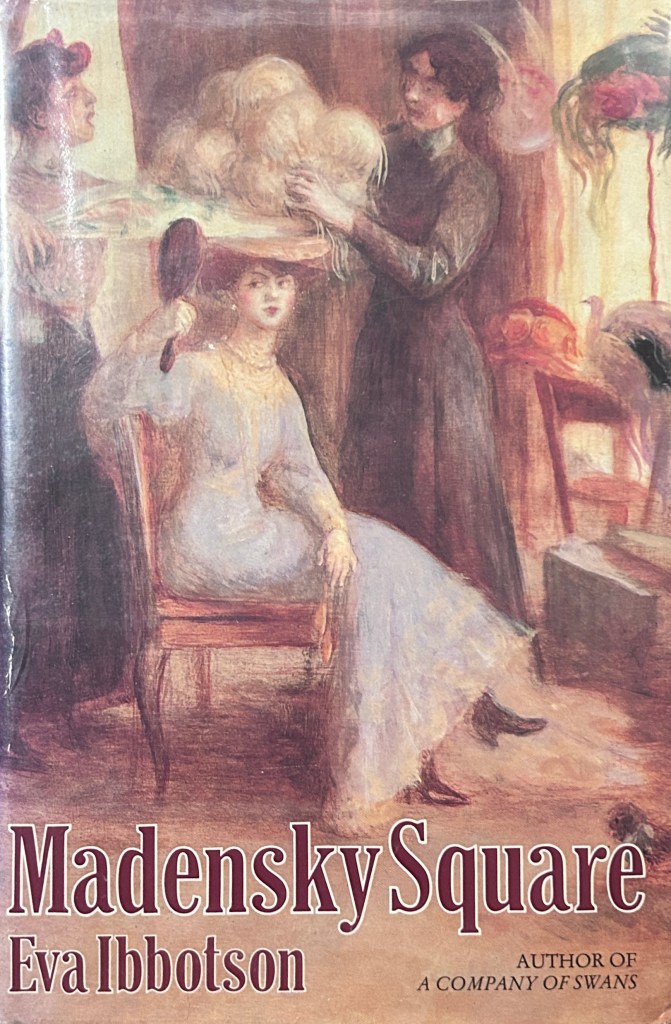
Susanna Weber, 36, is the highly regarded, talented dressmaker, and owner of a charming shop nestled in the vibrant Madensky Square. Set in Vienna, Austria, the book is told through Susanna’s intimate journal entries over the course of one year. During this time, we meet a variety of characters, including Susanna’s peculiar neighbors, her loyal, and at times demanding clients. We also meet her lover, Field Marshall Gernot von Lindenberg. Susanna has been in an extramarital affair with Gernot for 12 years; he is in a loveless marriage of convenience but is unable to divorce his estranged wife. Due to her shop’s location amidst this vibrant community, Susanna often finds herself intricately involved in the lives of her neighbors and fellow shop owners, forming friendships, facing challenges, and sharing in the joys and sorrows with the people of Madensky Square.
Susanna refers to Gernot as her “protector”, however she does not accept money or extravagant gifts from him – he is not independently wealthy, and she would refuse gifts and money anyway. Her reasoning is that she wants to be the one person in his life who does not ask more of him than he is able to give. It is common for romances featuring mistresses to include a scene (or scenes, just to make the point clear) where there is a gift of jewelry, or some other item of monetary value, that the mistress character refuses because she does not want to feel like a whore (is this the on-page feminism?). Susanna does not make this distinction between herself and a sex worker; she’s not wealthy but she is financially independent and was prior to meeting Gernot. She calls him as her protector because the first time they meet, she was found wandering and confused near a country estate.
When Susanna was 17, she eloped with a young military officer and later gave birth to a daughter who she was forced to give up for adoption. The officer left her for a military assignment before she realized she was pregnant; she never heard from him again after he left. A few years after her daughter’s birth, Susanna decides to find where she was placed and take her home with her. She eventually learns where her daughter lives, and she travels to her daughter’s home; she sees her playing with dolls outside a perfect house, in a beautiful yard. When her daughter’s adoptive mother steps outside, she sees Suasnna and recognizes the resemblance. Instead of going to her daughter, Susanna turns around and walks away. She wanders, devastated and consumed by grief.
It was in a place very like this [Count Osterhofen’s shooting box8] that I first met Gernot. Though “met” is not quite the right word. I was somewhat mad, walking – sodden – through the countryside and slightly off course of the Danube. (104)
Once found, Susanna is taken to a house, bathed, given clean clothes and placed in a warm bed. Gernot is brought to her room because she has refused to speak to anyone about her circumstances. He is eventually able to convince Susanna to tell him about herself and how she came to be found in such a disheveled state:
He then introduced himself formally, giving himself his full rank and title. “So you will be aware that anything you say to me will be treated in the strictest confidence.”
“Please don’t make me . . . It would be of no interest . . .”
“You are mistaken,” [ . . . ] Then suddenly I began to talk. [ . . .] I gave the whole story of my daughter’s birth, her loss, the agony and depressions . . . the sudden hope and joy as I realized I could care for her. [ . . . ] I told him about Sappho who had chided her daughter for anticipating grief, and how every child I’d seen for six long years had been her.”
His head was turned away from me toward the one candle that burned in the room. “I had a son. He died when he was five months old. He died, but I did not grieve as you grieve now.” (105-106)
Susanna shares more details of her life; he arranges for her to return home. Several months after this incident, Gernot goes to the shop Susanna works at, under the guise of buying dresses for his daughter. Susanna models the dresses for him at his request, subtly conveying her interest as he closely watches her. The next day, Gernot sends his secretary, Hatschek, to deliver an invitation to supper at the Hotel Bristol. The ritual of their future assignations is established.
Later he repeated that strange thing he’d said in the shooting box. “You can’t imagine how I envied you when you lay there so wild and distraught and desperate.”
“Envied me?”
He sat down beside me and pushed the hair from my face.
“To have felt anything so intensely, so utterly. To be so open to sorrow. I’ve never felt anything like that, Susanna. It’s what we all want, to be entirely open to life.”
And under the sheet my toes curled with happiness because he’d said my name. (109)
It’s not all toe-curling happiness and bliss being the secret mistress of an important officer. Susanna experiences doubt and disappointments; the stakes of miscommunication and misunderstanding are used effectively throughout the book. Because they are unable to communicate regularly or openly, Susanna and Gernot are bound to misinterpret the other’s actions: they cannot clarify their intentions over a telephone call, it is too risky to exchange letters back and forth, and they cannot be seen together publicly; they rely on Gernot’s secretary, Hatschek, to pass along infrequent, cursory messages.
Early in the book, Susanna encounters Gernot and his family at the opera. He ignores her, appearing bored and unconcerned. She spends the rest of the first act spiraling, thinking the worst of their relationship. That is until intermission and he finds her in the crowd, feigning to pick up a fallen handkerchief; he whispers, “Thursday.” How foolish she has been! Susanna understands his brush off was out of necessity and that nothing has changed between them. There was no need for such dramatics! Later, after the big misunderstanding of third act, and following a very long period without any communication, Gernot expresses his frustration with Susanna for thinking the worst and not trusting him more:
“You thought what?” he said furiously. “You were capable of that . . . meanness . . . after twelve years of knowing me? My God, don’t we have enough difficulties in our life without that kind of rubbish? Every meeting is like wading through shifting sand to an oasis.” (301) emphasis mine because this line causes me to swoon
I learned about Madensky Square after an internet search brought me to a Dear Author post about mistresses in romance,9 the comments section helped me put together a substantial list of books to read. But one comment stood out from all the others:10
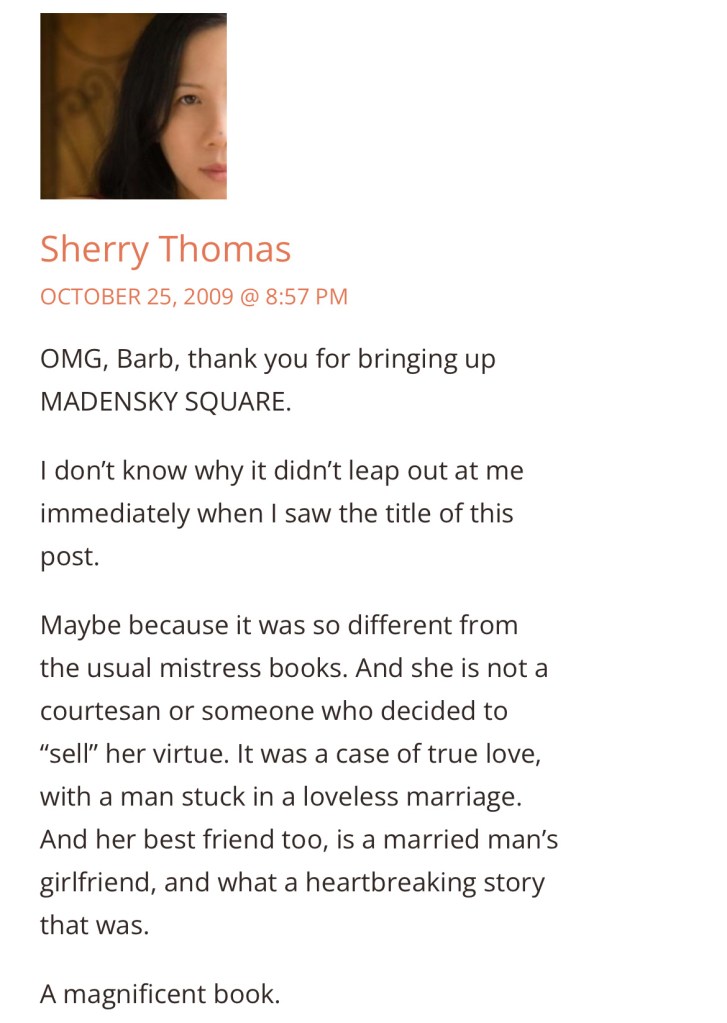
Thomas’s comment and the brief review she shared on her website, inspired me to find and read Madensky Square. This sounded like everything I was looking for- desire that builds after spending weeks and sometimes months apart, beautiful, fleeting stolen moments, lives finally converging in hotels and rented homes over short weekends, high stakes! This book has all those things (and a gut-wrenching third act), and it works so well, probably because it is not genre romance, it’s historical fiction with a romantic subplot.11 Romance readers may take issue with Susanna for being in a long-standing affair with a married man; they might question the morality of such a character attaining an HEA.12 And some readers may find themselves unsettled by the end of the book: Susanna remains Gernot’s mistress, and he does not divorce his wife. Susanna does not make moves to achieve societal validation by insisting Gernot marry her; rather, she finds fulfillment in owning her shop, being an integral member of her community, and cherishing the always-too-brief evenings and weekends she spends with Gernot.13
I wanted to write about this book because, to me, it felt like such a departure from the typical romance arc that often seeks to redeem (validate? elevate?) similar characters (usually through marriage) and it inspired me to think more deeply about autonomy and love in relation to romance – its readers, authors, and works. Susanna’s life is fully realized outside of Gernot and she lives for their time together. Madensky Square also brought up some messy feelings I have about genre romance’s understanding of community. I don’t know if I’m capable of coherently writing about these feelings, but what Morgan says here from the ShelfLove/Whoa!mance episode Problematizing Romance has stuck in my head:
I think you know the HEA itself, like a wedding, a marriage, heteronormative monogamous ending, as pleasurable as they are to arrive at when you’re reading a book, like it doesn’t take much poking to see that that idea of fulfillment comes through marriage or through arriving at one of those relationships is a patriarchal project because it suggests that that you need to [. . .] think of yourself as part of a twosome, right, to create your own family unit which immediately is also capitalistic because it takes you out of the idea of the collective in some ways.
Marriage of (Actual) Convenience
Marriage of convenience – in which two people marry for reasons other than romantic love – is a popular romance trope, especially in historical romance . . . which is why I am surprised the trope hasn’t been turned on its head more often. Like, where are all the characters in a true marriage of convenience, who have extramarital romances?14 I’m thinking specifically of Leo Marsden’s mother’s extramarital relationship with his godfather and biological father from Sherry Thomas’s Not Quite a Husband. The man Leo’s mother is married to, and who Leo considers his father, supports his wife’s relationship with another man and the three are friendly:
“He is your natural father, isn’t he, your godfather?”
He glanced up from the board. Her eyes were the deep green of the underlayer of a glacier, her skin as clear as a snow-fed lake.
“Yes,” he said. Very few people knew. But then, very few people cared about the paternity of a fifth son . . . When Leo finally plucked up the courage to ask the earl whether it bothered [his father] in any way that he had under his roof someone who was not of his own flesh and blood, Lord Wyden had only smiled and said, “All you need to know is that you are the son I’ve always wanted.” . . . In the end, there had been more than enough affection and esteem to go around. (99)
I think about these characters often because I want to read their romance novel! I believe in their HEA and that it was possible based on their circumstances; and to me, their stories are worth exploring in depth. Sex worker and writer Jessie Sage recently wrote something that resonates with me and speaks to what I think romance novels can (and often do) explore:
We live in a culture that assumes that love only comes in very prescribed forms, particularly romantic and sexual love. And yet, I have been in this (sex) industry long enough to know that human beings are far more complex than this and there are many different ways to love and be loved.
What’s Next?
Coming Soon: The agony and ecstasy of Signet Regency Historical Romances! Two books featuring mistresses: Joan Wolf’s His Lordship’s Mistress and Mary Balogh’s Tempting Harriet, then Romance Feminism Might Actually Be Whorephobia: an emo rant (jkjk but maybe for real). The Mistress Series will continue for as long as I keep reading these books.
Un-Related to the Mistress Series: Katrina Jackson’s Back in the Day (Bay Area Blues Book 2) and The Tenant . . . I appreciate how Jackson tests the constraints of the ill-defined HEA with these two books.
War and Peace updates monthly-ish!
Further reading
Anya Seton’s masterpiece Katherine about Katherine Swynford, mistress of John of Gaunt, Duke of Lancaster. A remarkable work of historical fiction that I cannot recommend highly enough. Katherine and John eventually marry and the children they had are made legitimate.
Working It: Sex Workers and the Work of Sex edited by Matilda Bickers with peech breshears and Janis Luna
I think the essay on enthusiastic consent is important because the author points out the people credited with defining “good” consent exclude sex workers. from my Goodreads review: So often when people talk about bodily autonomy, they are referring to – almost exclusively – reproductive rights; completely avoiding (out of ignorance or just plain anti-sex work/er biases) any inclusion of sex work or sex workers. This oversight does not go unnoticed – sex workers are the people on the front lines of advocacy in regard to abolition, the entire spectrum of bodily autonomy, LGBTQIA+ rights, anti-carceral, and anti-policing – you fucking name it, sex workers were there first.
Romance Discoursing by Sanjana at Scratch Paper
“The trouble with constantly engaging in a quest for romance’s recognition by an outside party is that it distracts us from having useful critical conversations in-community.”
Sanjana is brilliant and everything she writes here is so, so important.
The Data Does Not Exist to Support “Romance is a Billion Dollar Industry”
“Sorry, the data we’re looking for really doesn’t exist — definitely not in 2024, and we should also scrutinize the credibility of RWA’s reports, which haven’t even been updated since 2013.”
I think this piece pairs well with Sanjana’s because anytime the value of romance comes into question, too many folks are ready to defend romance’s honor with bad data: “Romance is Good, Actually, Because it Brings in Billions $$$. . .” what if I told you the research pushes back against this understanding? what if we didn’t link our enjoyment of something with how much money it made for a corporation? what then, could we all be free?
Please consider donating to the Internet Archive which made this project possible. And then donate to the Free Speech Coalition to help fight against online age verification laws.
While working on this post, film director and artist David Lynch died. I have so much gratitude for David and for the art he created and shared with us ❤
- I am uncomfortable making a blanket statement that a book is “good” with regard to representation of a stigmatized population – one that romance is often comfortable participating in further stigmatizing. I think more romance readers should pause to consider if they are capable of deciding what constitutes good representation. Some of the books I’ll be writing about have excellent, swoony romances but also include questionable representation of sex workers. This cognitive dissonance is what I’m interested in exploring! ↩︎
- “the judgement and negative stereotypes associated with people who do sex work. Whorephobia pervades all aspects of my life as a sex professional. The laws that try to control what I do, the way my work is described in the media, the attitude of the people around me – all of this is shaped by those negative judgements.” https://tryst.link/blog/whorephobia-is-a-problem-for-everyone/ ↩︎
- A similar plot features in Elizabeth Hoyt’s Wicked Intentions. Hoyt’s books read to me like the complaints current romance readers make about what they perceive as old-school romances: that they are insensitive or weirdly offensive. Wicked Intentions, the first in her Maiden Lane series, was published in 2010. I do not mention Hoyt and Ashley’s books because I think people shouldn’t read or enjoy them. My intent is to be specific about where I have encountered poor representations of sex work/ers. ↩︎
- Romance Labor: on Sean Baker’s Anora by Marla Cruz https://angelfoodmag.com/romance-labor ↩︎
- “I invented sex work. Not the activity, of course. The term. This invention was motivated by my desire to reconcile my feminist goals with the reality of my life and the lives of the women I knew. I wanted to create an atmosphere of tolerance within and outside the women’s movement for women working in the sex industry.” Unrepentant Whore: The Collected Work of Scarlot Harlot, Leigh, Carol, pg. 22 ↩︎
- The happily ever after is a genre requirement for a work of fiction to be considered a romance. ↩︎
- Whenever I read a romance think-piece about how the genre is now progressive, I am reminded of what Andrea from ShelfLove wrote: “Modern readers who are newer to the genre and familiar with the current norms may be surprised to learn that sexier adventure-focused historical epics from before and after this time frequently depicted heroines engaged in both violent and consensual sexual encounters with many men other than her eventual mate. This is understood as a total no-no today: you decide if this is progress.” ↩︎
- A cabin used during hunting season. ↩︎
- When I tried to go to this page in January, 2025, I received a 404 error. This is from the Internet Archive: http://web.archive.org/web/20230604142739/https://dearauthor.com/need-a-rec/if-you-like-misc/if-you-like-romances-featuring-mistress/ ↩︎
- I am sharing this screenshot in case, for some reason, the Internet Archive’s link stops working, too. ↩︎
- The 1988 Avon paperback of Madensky Square says “Avon Romance” on the spine; the book is classified as historical fiction everywhere I have searched. I will say, each time I’ve reread this book, the romance plot feels weightier and more significant. I am unconcerned with how it’s classified, but I recognize the ways this book may not be well-received *as a romance* to some readers. ↩︎
- Judith Ivory once spoke about the judgement her character, Coco, a former courtesan, from her book Sleeping Beauty, received from readers: “She enjoyed what she’d done once she realized that this was what she had to do. My editor thought – and I agree – there would be readers who would cringe every time she mentioned liking her relationships to married men. I was dodging a moral judgment on her, which was tricky, given what she’d done for living. In terms of the integrity of the book, I decided her comfort with herself and her continuing relationship with many of the man she’d slept with spoke enough about how she felt. She didn’t blame herself for coping the best she could in a time when women had few choices. She took what pleasure there was to have from the situations life provided.”
https://allaboutromance.com/author-interviews/interview-with-judith-ivory-2/ ↩︎ - I do think a not-small contingent of historical romance readers would love that Susanna is a Woman Business Owner™️. ↩︎
- Alexis Hall’s December 2024 release, Something Extraordinary, is a marriage of convenience between a gay man and an aromantic, pansexual woman; they elope as friends and partners. Caz’s review summarizes the book quite well: Something Extraordinary (Something Fabulous #3) by Alexis Hall – Caz’s Reading Room ↩︎
 scarr
scarr 